

WHERE LEGAL DEPARTMENTS RANK ON THE MATURITY INDEX (BY DIMENSION)
Performance measurement leads; strategic planning trails.
--1.png?width=960&height=510&name=Budgeting%20Teaser%20Graphics_WHERE%20LEGAL%20DEPARTMENTS%20RANK%20ON%20THE%20MATURITY%20INDEX%20(BY%20DIMENSION)--1.png)


There's a budgeting revolution underway. New research examines why half of in-house legal departments are scrapping traditional budget models—and what's next.
Axiom's 2026 Global In-House Legal Department Budgeting Study, conducted by The Harris Poll among 530 senior legal budget decision-makers, reveals that 49% of legal departments shifted their budgeting approaches in the past year alone—and the transformation to value is accelerating. Here's an exclusive preview of the full report.
For the first time, we can quantify exactly where legal departments stand on their journeys from cost centers to strategic partners. The inaugural Legal Budget Maturity Index—developed in partnership with the Harris Poll and commissioned by Axiom—reveals that while the transformation to value-based budgeting is clearly underway, most departments are still in the middle of their journeys.
The Index measures five critical dimensions that separate cost centers from value creators:
With an average score of 64 out of 100, most legal departments hover in mid-maturity territory. They excel at performance measurement (73) and have gained reasonable authority (68) but critically lag in value orientation (58) and strategic alignment (58)—the very capabilities that enable the shift from cost center to strategic partner.
These aren't just abstract metrics. The Index reveals significant variation in budget sophistication, with the highest-performing departments demonstrating stronger capabilities across all five measured dimensions. The results suggest that departments excelling in these areas are better positioned to transition from cost centers to strategic value creators.
FIGURE 1
This comprehensive study of 530 senior legal budget decision-makers—CLOs, GCs, and CFOs—at enterprise organizations across eight countries reveals not just where legal stands today, but the specific gaps preventing the full transformation to value-based operations. The findings? Nearly half (49%) of legal departments changed their budgeting models in just the past twelve months, with another 36% planning additional changes in 2026.
The journey from cost center to strategic partner isn't just aspirational anymore. It's happening right now—but at dramatically different speeds.
Get the Full Report UNLOCK VALUE
Perhaps the most intriguing finding in the research is what we're calling the CFO-Legal Partnership Paradox. While 89% of legal budget decision-makers (CLOs/GCs) and 86% of CFOs rate their relationships as "excellent" or "very good," there are critical execution gaps that undermine these positive feelings and prevent the transition to value-based budgeting.
FIGURE 2
The disconnect is stark: 50% of CFOs believed they control legal budget-setting, while only 32% of legal leaders believed their CFOs have independent budget-setting authority, revealing confusion about who actually owns the process. Despite "approved" budgets, 86% of legal departments reported they still needed multiple approvals for spending decisions. While leadership relationships are strong, only 33% conduct comprehensive annual ROI evaluations collaboratively.
The message? Legal and finance leaders genuinely like and respect each other, but they're not speaking the same language when it comes to budget authority and value creation. This communication gap suggests there is friction that slows decision-making and limits legal's ability to demonstrate strategic value.
The shift from traditional budgeting models tells a powerful story about the journey to value. Over a third (37%) of legal departments have adopted hybrid approaches that blend structure with flexibility—a critical step toward value-based budgeting that enables rapid response to business needs.
The organizations most interested in evolving to value-based performance are moving beyond hybrid models to true value-based budgeting, where budgets are engineered to drive measurable business value and team performance. These leaders aren't just managing costs; they're creating flexible resource pools that can pivot as quickly as their businesses do.
This shift isn't happening in a vacuum. Legal departments are responding to unprecedented pressures: regulatory changes that can't wait for next year's budget cycle, M&A activity that demands instant resource mobilization, cybersecurity threats requiring immediate legal response, and AI initiatives that weren't even conceived when last year's budget was set.
The old model—where legal departments submit annual requests and lobby when their total ask is denied—simply can't demonstrate or deliver strategic value at modern business velocity.
Get the Full Report EXPLORE FLEXIBLE SOLUTIONS
Here's a number that should make traditional law firms nervous: 68% of legal budget decision-makers said they would switch from traditional firms to ALSPs with just a 30% (or lower) cost differential.
Not 50%. Not 40%. Just 30%.
FIGURE 3
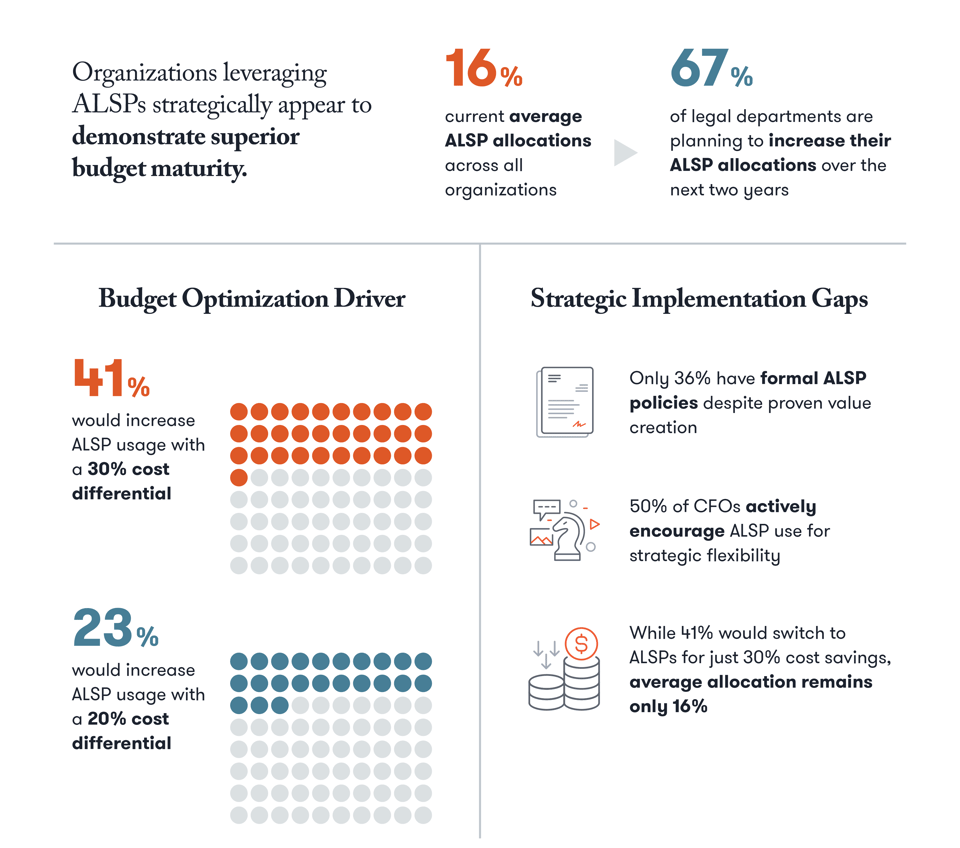
But this isn't about cutting corners. It's about reaping more business value. The Legal Budget Maturity Index includes ALSP adoption as a key dimension of budget sophistication, and with average ALSP spend now reaching 16% across all organizations, forward-thinking departments are recognizing ALSPs as strategic partners rather than just cost-cutting measures.
Moreover, half of CFOs (50%) actively encourage their legal departments to use flexible talent and ALSP models. When selecting ALSPs, legal leaders prioritize factors beyond cost savings, including quality assurance (50%), specialized expertise (43%), and scalable capacity (38%).
Despite this encouragement from CFOs, only 36% of legal leaders reported they have formal ALSP usage policies in place. Closing the gap between CFO encouragement and actual policy implementation is an "elephant in the room" opportunity for legal departments to accelerate their transformation from cost centera to value creators.
Get the Full Report TRANSFORM YOUR BUDGETING
Perhaps the most troubling finding on the journey to value involves artificial intelligence implementation. An overwhelming 78% of legal budget decision-makers reported they're expected to implement legal AI without dedicated funding. Nearly a third (31%) said this happens frequently.
This creates an impossible situation for value creation. Legal departments are being asked to fundamentally transform their operations using technology that requires significant investment in legal AI tools, training, and talent—all while their budgets remain flat or are declining.
The response has been creative but concerning. Most legal leaders (56%) reported they're raiding existing technology budgets to fund legal AI initiatives. Despite these funding challenges, legal departments aren't backing away from AI. Nearly half (49%) now formally evaluate whether AI can perform certain tasks before creating new full-time positions, a clear sign of the push toward value optimization even without proper resources.
Get the Full Report Explore AI-Enabled Legal Talent
Looking to 2026 and beyond, the transformation of in-house legal budgeting is accelerating. Over four in five (83%) of senior legal officers anticipate that their teams will need fundamentally different skills in the coming year, with a third (32%) anticipating a significant difference in skills needed. Most senior legal officers plan to budget and invest in data analytics and legal technology (45%) over the next year, suggesting these may be crucial capabilities for value creation.
This skills evolution has profound implications for the journey to value. Departments must fund not only current operations but also the reskilling of their workforces and budget for new types of talent that didn't exist in legal departments just five years ago, all while maintaining operational excellence and demonstrating measurable business value.
The corporate legal budgeting revolution isn't coming. It's already here. The data shows nearly half of legal departments (49%) have already transformed their budgeting models, with more changes on the horizon (36% plan to make budgeting model changes in 2026). Those clinging to traditional cost-center approaches risk being left behind as more agile competitors leverage flexible models, alternative talent strategies, and strategic finance partnerships to deliver superior value.
The path forward involves embracing hybrid budgeting models, integrating ALSPs strategically, strengthening CFO partnerships, and shifting focus from cost management to value creation.
Ready to benchmark your legal budgeting maturity? Our comprehensive 2026 Legal Budget Report provides detailed analysis across the five key maturity dimensions, insights from 530 senior legal and finance executives across eight countries, and strategic recommendations for advancing your department's budget sophistication.