


By 2028, 40% of all legal negotiations will incorporate an AI element. But for general counsel (GCs) and legal operations leaders, this isn't a distant future scenario. It's happening now, and understanding how to harness AI-powered contract management is becoming essential to maintaining a competitive advantage.
As legal teams face mounting pressure to do more with less, AI contract management solutions offer a compelling answer. These tools are transforming every phase of the contract lifecycle management process, from initial drafting through negotiation, execution, and post-contract monitoring. But with rapid adoption comes critical questions: What exactly can these systems do? How do you choose the right contract management solution? And what risks must legal professionals navigate?
Drawing from insights shared by Robin French and Leslie Bennett, both Commercial Counsel at Axiom, during our recent CLE program on commercial contracting in the AI era, this article explores what legal teams need to know about AI contract management and how to implement these contract management tools effectively.
What Is AI Contract Management?
AI contract management refers to the use of artificial intelligence systems to automate, enhance, and streamline the contract management process. At its core, these contract management systems leverage several types of AI technology to handle tasks that traditionally required significant human expertise and time.
Machine learning enables these systems to learn from data patterns, continuously improving their analysis as they review more contracts. Natural language processing allows the software to understand and respond to human commands, similar to how virtual assistants like Siri operate. Predictive analytics review historical contract data to identify trends and inform negotiation strategies. And robotic process automation handles repetitive tasks that would otherwise consume valuable attorney time.
The sophistication of AI-based contract management has evolved considerably. Modern contract management software can now automatically scan and analyze contracts, identifying key clauses, potential risks, and inconsistencies much faster than any human reviewer. These AI tools integrate with existing technology stacks, from Microsoft Word to comprehensive contract lifecycle management platforms, making adoption more seamless for legal operations teams.
As Leslie noted during the presentation, “AI tools are revolutionizing the way we manage contracts,” fundamentally changing how legal departments approach everything from document review to compliance monitoring.
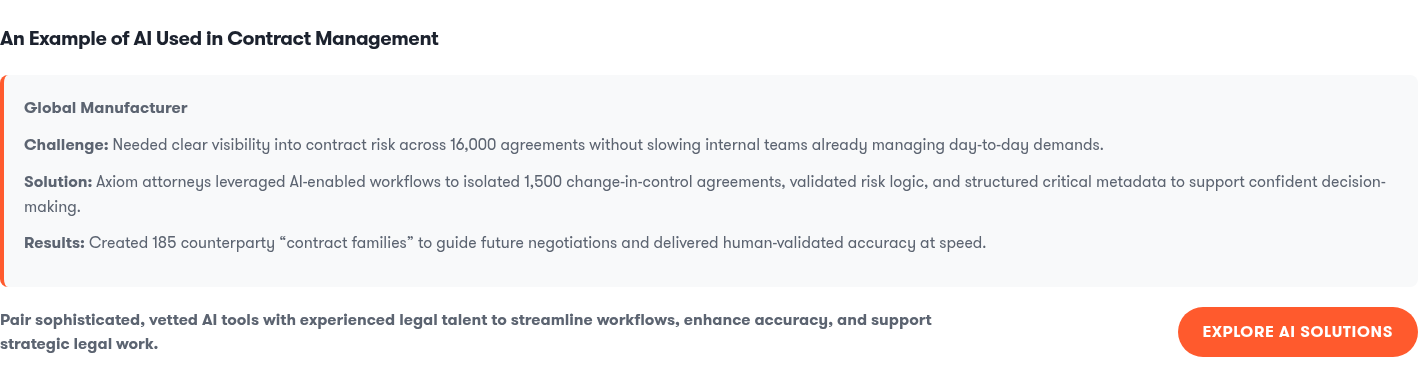
AI delivers the strongest results when experienced attorneys shape its implementation.
How AI Is Changing Contracts
The impact of AI on contract management spans the entire contract lifecycle, touching negotiation, drafting, analysis, and ongoing management in ways that would have seemed impossible just a few years ago.
In the contract negotiation phase, AI provides data-driven insights that give legal teams strategic advantages. These systems can rapidly process large contract datasets, identifying patterns across hundreds or thousands of agreements. This pattern recognition capability allows legal professionals to understand their negotiation history at a granular level—seeing where they've consistently made concessions on limitation of liability clauses, for instance, or identifying optimal terms based on historical performance.
Robin emphasized the importance of this capability: “Predictive insights for negotiations allow you to see how you're doing over time in your various contract negotiations. Are your contracts consistent over time? Are you making changes in certain areas consistently?”
Real-time communication features, including AI-powered chatbots, are streamlining interactions during negotiations. These tools provide twenty-four-hour availability, instant access to contract information, and streamlined communication between parties, particularly useful for routine agreements like NDAs or standard order forms.
Perhaps nowhere is AI's impact more immediately felt than in drafting and review. AI-powered contract management solutions can generate clause suggestions tailored to specific contract types, drawing from comprehensive clause libraries. These systems offer innovative suggestions for standard provisions and enable template enhancement and personalization at scale.
The efficiency gains are substantial. As French noted, accelerated clause drafting and review lead to “faster turnaround times, which is always a goal and always appreciated in every environment, by clients, by business stakeholders, and others.” Reduced manual effort means less time spent on repetitive reading and more time for strategic legal work.
Tools like Draft Pilot, which integrates directly with Microsoft Word for inline redlining, exemplify this new generation of contract management tools. Legal teams can work within familiar environments while leveraging AI to dramatically reduce the time-consuming aspects of contract review.
AI excels at contract analysis, providing insights that would be impractical to generate manually. These systems can conduct contract clause analysis across entire portfolios, identifying optimal terms and mapping contractual obligations to ensure responsibilities are properly assigned within organizations.
Risk analysis capabilities are particularly valuable. AI can identify potential exposures such as instances of uncapped liability scattered across numerous agreements, allowing legal teams to make data-driven decisions about template adjustments and attorney guidance.
Bennett highlighted the scope of current applications: “Within document review and analysis, one of the most significant applications of these tools is that they can automatically scan and analyze contracts, identifying key clauses, potential risks, and inconsistencies much faster than a human could.”
The contract management process doesn't end at execution, and AI tools are transforming post-contract phase management as well. Automated monitoring of obligations tracks how contracts flow through organizations, when they're received, when redlines are exchanged, and when deals close. Deadline tracking and alerts ensure critical dates don't slip through the cracks.
Performance analytics and reporting provide visibility into contract portfolio health. Document organization and indexing make it possible to search for specific agreements or clauses across thousands of documents without manually opening folders or reviewing multiple versions. Version control and tracking, a daily challenge for most legal teams, becomes significantly more manageable.
Benefits of AI for Contract Management
The advantages of implementing an AI contract management solution extend across multiple dimensions, from operational efficiency to strategic positioning.
The most immediate benefits are operational. AI-powered contract management delivers faster turnaround times, reduces manual effort, and lowers legal costs through better resource allocation. By automating administrative tasks and routine contract review, legal professionals can focus on more complex, high-value work.
French highlighted the cost implications: “You have efficiencies: cost savings, reduced billable hours for routine tasks, and better resource allocation. You have the ability to use your time in more complex areas than having to use your time just reviewing the contract itself.”
For legal departments operating with limited resources, these efficiency gains are transformative. The same team can handle significantly higher contract volumes without sacrificing quality or burning out.
Beyond pure efficiency, AI contract management tools provide strategic advantages through comprehensive data analysis. Predictive risk assessment and mitigation capabilities help legal teams get ahead of potential problems. Market intelligence and benchmarking features reveal trends across contract portfolios, informing template updates and negotiation strategies.
Commercial compliance monitoring becomes more robust when AI systems can review entire contract portfolios to identify agreements that don't align with current regulatory requirements, critical as data protection laws and other regulations continue to evolve.
Personalization capabilities enable relationship-based negotiations. As French explained, AI can “review contracts that you may have with a specific client,” particularly valuable when you have buying and selling relationships with the same entity. Understanding historical agreements provides crucial context for new negotiations.
In an era of increasing regulatory complexity, AI tools assist with compliance monitoring by tracking changes in real-time and automating reporting requirements. This is particularly relevant for legal teams navigating regulations like GDPR, CCPA, and emerging AI-specific frameworks like the EU AI Act.
For e-discovery, AI has fundamentally changed the game. Tools like Relativity and EverLaw use AI to streamline discovery processes, efficiently retrieving and analyzing large volumes of data. As Bennett noted, this represents a dramatic shift from earlier eras when there were “document lawyers whose entire jobs were to go through piles and piles of papers in discovery.”
How to Choose AI Contract Management Tools
Selecting the right AI solution requires careful evaluation across multiple dimensions. Both French and Bennett emphasized that success depends on balancing technology capabilities with careful oversight and strategic implementation.
Before evaluating any contract management software, clearly articulate what you aim to achieve. What specific challenges within your practice can AI address? Are you struggling with contract review backlogs? Missing renewal deadlines? Inconsistent negotiation approaches? Compliance risks?
Bennett stressed this foundational step: “Clearly articulate what you aim to achieve with this AI, identify specific challenges within your practice that AI can address that will help to frame the context and the contours of choosing specifically the right tool for your practice.”
The effectiveness of any AI-based system depends on the data it uses. Assess data compatibility with your existing contract portfolio. Consider whether the vendor uses open data models (allowing broader access to external datasets) or closed data models (relying on proprietary sources). Each approach has tradeoffs between adaptability and control.
Create an evaluation dataset, or a representative sample reflecting various scenarios relevant to your practice. Test potential tools against this dataset to evaluate accuracy and relevance in real-world applications.
French also warned about data quality issues: “Garbage in, garbage out. So it's very important that when you're implementing an AI system, [...] you are very attentive to the data that's going in, that there's consistency in the way the data is being put in.”
Core functionality should align with your defined objectives. Does the contract management solution provide the features you need, like automated review, predictive analytics, and contract drafting support? Is the interface user-friendly enough that it requires minimal training?
Integration capabilities are critical. The tool must work seamlessly with your existing technology stack, including case management systems, document management platforms, and communication tools. Poor integration creates friction that undermines adoption.
Scalability matters significantly. North America leads in advanced AI adoption, with 76% of companies having mature AI deployments. As Bennett noted, “governance solutions being developed today must be scalable enough to not only handle the current AI deployments, but also the significant expansion coming as the remaining third of organizations mature their AI capabilities.”
Data privacy and security considerations cannot be an afterthought. Ensure any AI contract management system complies with relevant data protection laws. Evaluate how vendors handle sensitive client information, what encryption and security measures they employ, and whether their cybersecurity protocols are robust.
French emphasized the stakes, stressing that legal teams must carefully safeguard sensitive contract information, prevent improper use, and maintain clear awareness of how data is handled when deploying AI products.
This is particularly critical when using open AI platforms. French cautioned strongly against putting confidential information into free AI services: “If you're using any of the very open AIs such as Claude or OpenAI, you must be very, very concerned and very careful that you're not putting in confidential information, client names, any personal information.”
Assess potential algorithmic biases that could lead to unfair or inconsistent outcomes. Require transparency from vendors about how their algorithms work and what processes they use for testing and mitigating bias.
And keep in mind that technology alone isn't the answer. Bennett stressed that “while AI can obviously enhance efficiency greatly, human [...] oversight is crucial to ensure quality and compliance.”

Effective AI governance requires both structural/technological elements (audit trails, user access controls built into the AI tools) and operational/procedural elements (attorney-implemented best practices, verification of AI outputs, ensuring legal standards are met). It is often a good idea to consult an artificial intelligence lawyer to help develop best practices.
Never rely blindly on AI outputs. French warned, “The algorithm is not going to look and say, 'Oh my goodness, maybe we need to address and review our clause to see why we are consistently having to make this change. It's not going to make that analysis. That's an analysis that you will need to make.”
Look for vendors that provide clear information about their AI models, including what data they train on. Assess their commitment to ethical AI practices and ongoing compliance with evolving regulations.
The EU AI Act, which comes into full effect in August 2026, includes substantial penalties for non-compliance, up to 7% of total revenue or €35 million, whichever is greater. While U.S. federal legislation hasn't yet materialized, French anticipated that states will begin adopting similar frameworks: “I suspect we'll start to see states addressing it, adopting some version of that act.”
Several ethical and practical considerations deserve special attention as legal teams implement AI contract management solutions. AI doesn't operate in a cultural vacuum. French highlighted the importance of understanding cultural nuances: “Certain cultures like to have person-to-person meetings. Other cultures are comfortable with AI. But the bottom line is culture has been around for many years, a lot longer than AI.”
Be transparent about AI use in negotiations. Let counterparties know that AI is part of your contract management process, and adapt your approach based on their comfort level. Transparency should be communicated in a way the other party can understand, whether through email, conversation, or document notation, and ensure all relevant parties are informed.
The most successful AI implementations balance AI capabilities with a human touch. AI tools should augment legal professionals, not replace them. Complex judgment calls, nuanced negotiations, and strategic decisions still require experienced attorneys.
As Bennett noted, legal professionals must avoid “blind reliance on AI tools,” maintaining oversight to ensure quality and compliance. Establish clear protocols for when attorney review is required and develop metrics to assess both the effectiveness of AI tools and their ethical implications.
Potential algorithmic discrimination remains a persistent concern. AI systems trained on historical data may perpetuate existing biases in contract terms or negotiation approaches. Regular testing and monitoring are essential to identify and mitigate these biases.
French emphasized the importance of “always making sure that the way the algorithm is working is going in the direction that you need. Is the algorithm looking and making analysis and changes that are not consistent with the areas that you want covered?”
The future of contract management is already here. AI is revolutionizing how legal teams draft, negotiate, analyze, and manage contracts, delivering significant benefits in efficiency, cost reduction, and risk management.
But success requires more than simply adopting new contract management tools. Legal teams must carefully evaluate solutions, implement robust governance frameworks, address ethical considerations, and maintain appropriate oversight. For general counsel and legal operations leaders, the question isn't whether to adopt AI contract management. It's how to do so strategically, responsibly, and effectively. The legal departments that master this balance will be well-positioned to handle growing workloads, provide better strategic support to their organizations, and deliver more value with existing resources.
Need help implementing AI contract management or handling the increased efficiency it creates? Axiom's network of experienced legal professionals can provide specialized support for contract review, AI implementation projects, and routine overflow work—allowing your team to focus on strategic priorities while maintaining quality and compliance.