



Your legal team looks healthy on paper. Employee satisfaction surveys come back positive. Compensation is competitive. Everyone seems engaged in meetings. But beneath that surface calm, you’re likely sitting on a retention time bomb.
Our latest research reveals a sobering truth: nearly half of in-house legal professionals are actively job searching, even when they report high satisfaction with their roles. Traditional engagement metrics are masking a talent crisis that’s costing organizations hundreds of thousands of dollars in turnover costs and lost institutional knowledge.
The good news? We’ve identified exactly what’s driving this exodus—and discovered a solution that cuts attrition risk in half.
FIGURE 1
ALSPs REDUCE PRESSURE, BURNOUT, AND ATTRITION
Satisfaction Doesn’t Equal Retention
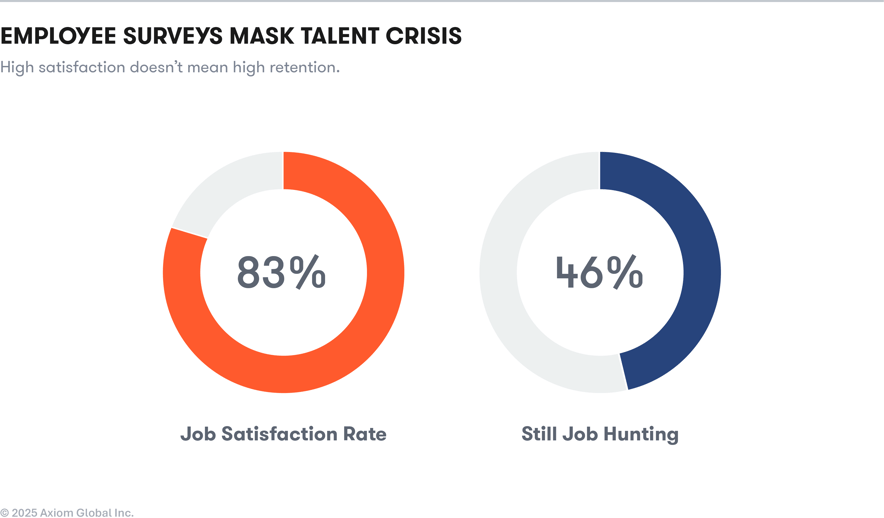
The 2026 Axiom Global In-House Talent Study surveyed 544 legal professionals across eight countries, and the findings challenge everything we thought we knew about retention. While 83% report high job satisfaction and 98% feel fairly compensated, 46% are already job searching. Even more concerning: of those considering a move, 56% would choose law firms over other in-house positions, signaling that in-house legal is now as demanding as private practice without always providing the resources needed to succeed.
So, if it’s not about satisfaction or pay, what’s actually driving people out the door?
Pressure Is the Real Culprit
The data reveals the true retention killer: operational pressure. In-house professionals facing high-pressure environments are ten times more likely to actively job search compared to those in low-pressure settings. And that pressure is coming from multiple directions simultaneously.
Nearly every respondent (97%) reports difficulty hiring quality talent, while 95% struggle to staff multidisciplinary projects. Add rising workloads (78% report increases) and growing complexity (77% cite this challenge), and you have a perfect storm driving burnout and attrition.
Only 39% of teams describe themselves as understaffed, suggesting the issue isn’t just headcount; it’s having the wrong mix of talent for today’s complex demands. Teams are staffed, but not staffed correctly.
FIGURE 2
The ALSP Advantage
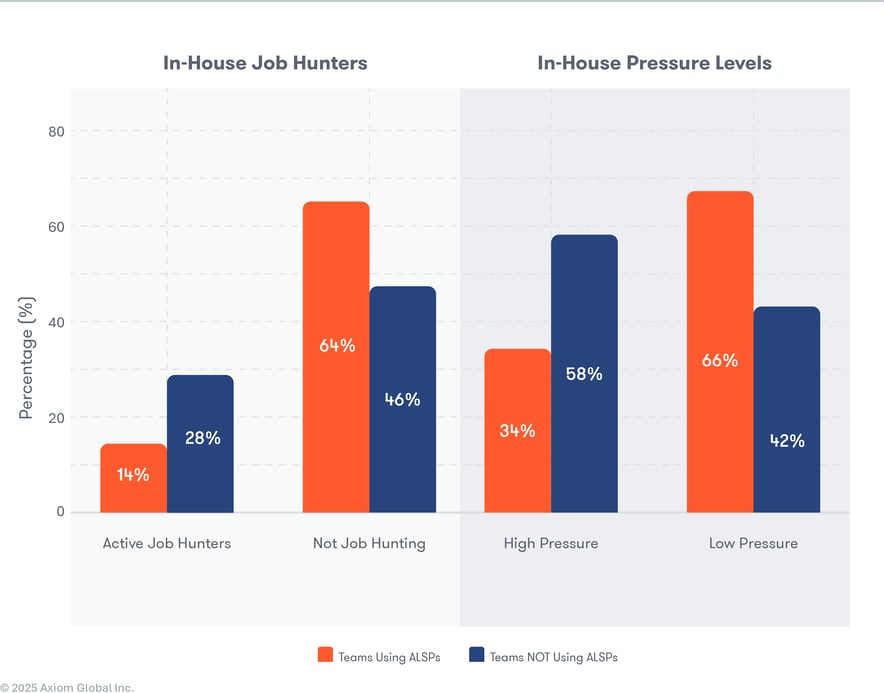
Here’s where the research gets really interesting. Departments that partner with alternative legal service providers (ALSPs) experience fundamentally different retention outcomes. Teams using ALSPs report only 14% actively job hunting, compared to 28% without ALSP support—a 50% reduction in talent flight risk.
Why such a dramatic difference? ALSP users report significantly lower pressure levels (34% high pressure vs. 59% for non-users) and higher engagement (64% not job hunting vs. 46% for non-users). When teams can flex capacity for peaks, access specialized expertise on demand, and handle overflow without burning out core staff, they create environments where professionals thrive instead of merely survive.
ALSPs are already the most popular resource solution, used by half of organizations to manage workloads, and rated more effective than hiring additional full-time staff, using traditional law firms, or bringing in temporary contract lawyers. The effectiveness stems from their ability to provide elastic scaling without long-term commitments, immediate multidisciplinary expertise, cost efficiency (capturing 50-70% better value per dollar), and pressure relief for permanent teams.
Explore how strategic ALSP partnerships reduce pressure, improve engagement, and support in-house teams without adding permanent headcount.
The Business Case Is Clear
The financial impact of ignoring this crisis is staggering. Research by the Society for Human Resource Management indicates that replacing a senior legal professional typically costs 50-200% of annual salary—translating to $300,000-$500,000 in hiring and onboarding costs, plus six to twelve months of reduced effectiveness while new hires reach full productivity.
Losing one senior attorney can exceed $500,000 in direct and indirect costs. Repeated turnover compounds annually, creating a drain on resources that far exceeds the investment in proactive solutions.
Compare this to strategic ALSP partnerships that prevent turnover before it happens, provide immediate access to senior talent, enable complex projects that drive business value, and offer AI-powered legal solutions that amplify capabilities—all while giving you the opportunity to test new talent before making conversion decisions.
A Global Challenge
The connection between pressure and job seeking is consistent globally, with most regions reporting four to six out of every ten employees experiencing enough sustained pressure to consider or start job hunting. Australia faces the most acute crisis (57% high pressure, 28% actively searching), while Singapore shows a troubling pressure-to-retention gap where even moderate pressure translates to significant flight risk.
The United States mirrors global patterns almost exactly (45% high pressure, 17% actively searching), validating that this retention crisis transcends regional boundaries and requires fundamental rethinking of how we resource legal departments.
What Legal Leaders Need to Do Now
The findings point to four critical actions:
- First, stop relying on satisfaction metrics alone. High satisfaction doesn’t mean high retention when operational pressure is crushing your team. Measure and address pressure points directly.
- Second, recognize that hiring more permanent headcount isn’t solving the underlying problem. With 97% reporting difficulty hiring and only 39% describing themselves as understaffed, the issue is strategic resource deployment, not just bodies in seats.
- Third, address AI anxiety alongside AI adoption. While 93% report AI makes them more productive, 76% fear it will replace them within five years. Success requires pairing technology with strategic partnerships that protect core team roles while expanding capabilities.
- Finally, fix ground-level operational friction. When 40% of staff experience tension with department leadership over basics like work prioritization and administrative burden, surface-level C-suite alignment means little.
In a market where 70% believe they must change employers to advance their careers (up from 57% in 2024), creating an environment where top talent chooses to stay isn’t just good HR practice—it’s a competitive necessity. The teams that figure this out aren’t just managing resources differently. They’re building sustainable competitive advantages by retaining staff, preventing the loss of top talent, and preserving costly institutional knowledge.