

.png)

Artificial intelligence has transformed legal departments overnight.
Forty-three percent of in-house legal professionals now use AI tools daily—a meteoric rise from just 54% reporting any familiarity with AI in 2024. Ninety-three percent say these tools make them "somewhat" to "significantly" more productive.
By every measure, the adoption of AI in legal should be a massive win. So why are three-quarters of your team worried they'll be replaced within five years?
Our 2026 Axiom Global In-House Talent Study surveyed 544 legal professionals across eight countries and uncovered a troubling reality: the same AI tools driving unprecedented productivity gains are simultaneously adding a new layer of anxiety to already-pressured teams. This AI paradox is becoming a critical factor in the retention crisis facing in-house legal departments worldwide.
The Explosive Growth of Legal AI
The AI adoption curve for legal has been nothing short of extraordinary. Nearly half of in-house legal professionals now use artificial intelligence daily, with another 47% using it several times per week. In practical terms, this represents weekly engagement with AI tools across the in-house legal profession, with 90% of practitioners actively utilizing these technologies.
The tools themselves span a wide range. ChatGPT leads adoption at 78%, followed by AI features embedded in existing legal software (69%), professional legal AI tools (56%), and other AI assistants like Claude, Gemini, and Copilot (46%). This isn't experimental anymore; AI has become infrastructure.
The productivity impact is undeniable. Two-thirds of users report being "somewhat more productive," while 27% say they're "significantly more productive." Only 6% report no impact. These aren't marginal gains; legal professionals are getting measurably more done with AI assistance.
But here's where the story takes a darker turn.
The Displacement Fear Factor
Despite—or perhaps because of—these dramatic productivity gains, 76% of legal professionals are concerned that AI will lead to job displacement. Only 24% feel secure in the face of advancing automation.
FIGURE 1
EFFECT OF PRODUCTIVITY GAINS
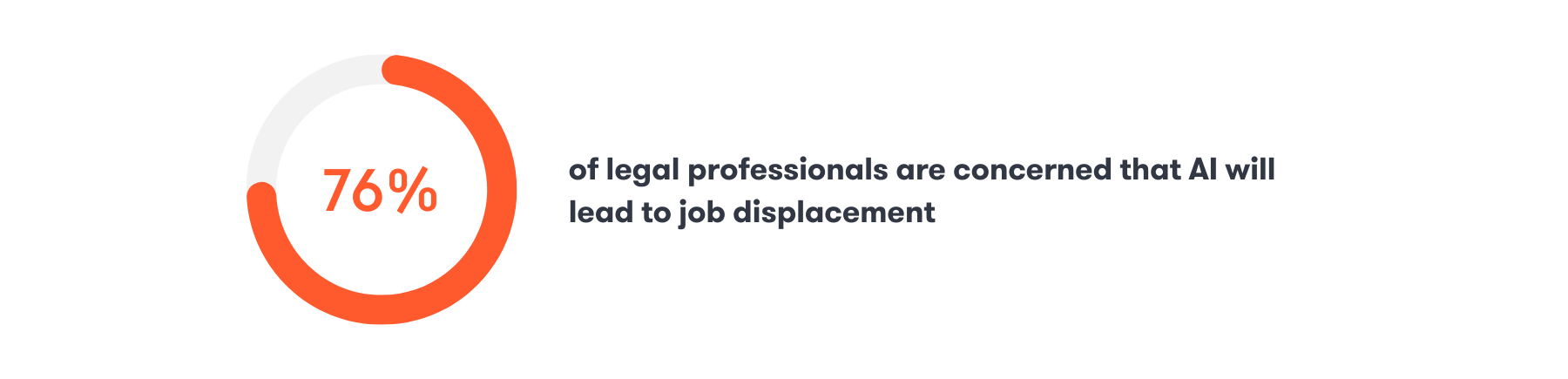
Think about that for a moment. The same professionals reporting that AI makes them more effective at their jobs are simultaneously worried it will eliminate their positions. They're experiencing the benefits while dreading the consequences.
This isn't just an abstract anxiety. Our research shows this fear is layering on top of already significant operational pressure. Seventy-eight percent of legal departments report increased project volume, 77% face growing complexity, and 95% struggle to resource and staff multidisciplinary projects. Now add existential concerns about job security to that mix.
The result? AI anxiety becomes another pressure point pushing talent toward the exit.
Where AI Implementation Is Failing
The disconnect between AI's productivity promise and its retention impact points to a fundamental implementation problem. Most legal departments are treating AI as purely a technology challenge when it's actually a people and strategy challenge.
Fewer than 40% of teams have implemented basic safeguards like usage policies or staff training. Organizations are rolling out powerful tools that reshape how legal work gets done without giving teams the guardrails, education, or strategic context to use them confidently.
Our comprehensive 2025 AI study revealed similar patterns: 89% of in-house legal teams increased AI usage, but most lack the support infrastructure to help them navigate this transformation. When technology races ahead of strategy and change management, anxiety fills the gap.
Consider the message this sends: "These tools will make you more productive" implicitly raises the question "Will they make me redundant?" Without clear communication about how AI will augment rather than replace legal professionals, teams draw their own conclusions—and those conclusions skew negative.
AI changes how legal work gets done. Teams need structure and support—not just new tools.
What's Working: Strategic AI Adoption with Flexible Capacity
The departments navigating AI successfully aren't just rolling out tools—they're rethinking their entire resource strategies. They're pairing AI adoption with flexible capacity models that provide security rather than creating competition between technology and people.
Here's what that looks like in practice:
Strategic partnerships provide surge capacity.
When AI enables one lawyer to do the work of two, but project volume increases by three times, you still need additional capacity. Alternative legal service providers (ALSPs) provide the flexibility without long-term headcount commitments that might later feel redundant.
Specialized expertise complements AI capabilities.
AI excels at routine tasks but still requires expert oversight for complex, high-stakes matters. Having on-demand access to specialists means core teams can focus on strategic work while AI handles volume, and experts handle complexity that's beyond AI's current capabilities.
Flexible models reduce displacement anxiety.
When teams see capacity problems solved through partnerships rather than permanent hiring, it's clearer that AI is a productivity tool rather than a replacement strategy. The presence of flexible resources signals that leadership is managing workload humanely rather than simply expecting fewer people to do more with AI.
AI-enabled ALSPs deliver better economics.
Modern ALSPs increasingly combine senior legal talent with their own AI implementations, delivering 50-70% better value per dollar than traditional law firms, and often more than AI alone could provide. This allows teams to expand capabilities without adding permanent overhead, addressing both the capacity problem and the cost pressure that might otherwise drive automation decisions.
The Data Behind Successful AI Integration
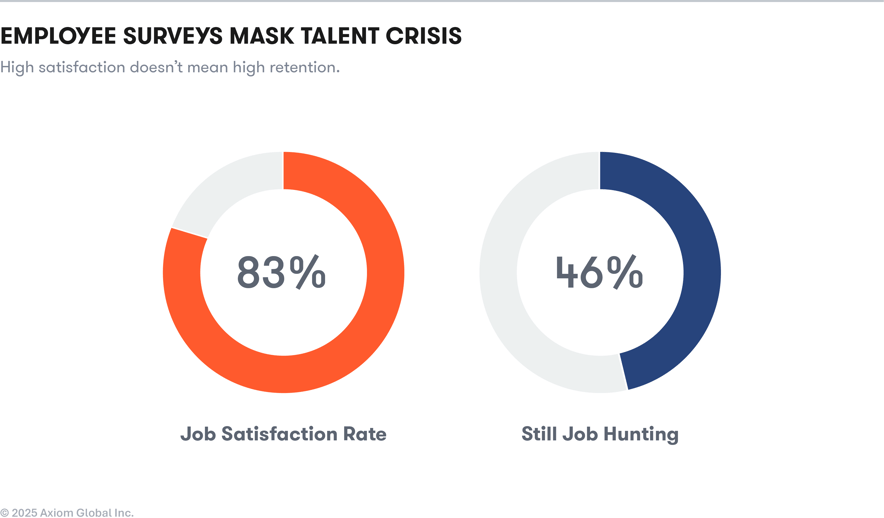
Our research reveals stark differences between departments managing AI well and those stumbling through adoption. Teams using ALSPs alongside AI report significantly lower pressure levels (34% vs. 59%) and better retention outcomes (only 14% actively job hunting vs. 28% for non-users).
FIGURE 2
This isn't coincidental. These departments have figured out that successful AI adoption requires answering two questions simultaneously: "How do we leverage AI's capabilities?" and "How do we ensure our team feels secure and valued?"
Technology alone answers the first question. Strategic resource partnerships answer both.
Four Principles for AI Implementation that Retains Talent
Based on our research, here are the principles that separate successful AI adoption from implementations that accelerate turnover:
1. Pair AI with flexible capacity, not headcount reduction.
When teams see AI coupled with strategic partnerships that provide surge capacity and specialized expertise, they understand technology is augmenting—not replacing—their capabilities. This visible commitment to sustainable workload management reduces anxiety and demonstrates that leadership values the team.
2. Communicate the AI strategy clearly and often.
Don't let teams fill the information vacuum with worst-case scenarios. Be explicit about how AI will change work, which roles are secure, what new opportunities will emerge, and how the organization will support people through the transition. Transparency reduces anxiety even when the future is uncertain.
3. Invest in training and guardrails before expecting results.
The fact that fewer than 40% of teams have basic AI policies or training programs is alarming. You can't hand people powerful tools, skip the education, and expect confident adoption. Training signals investment in people, not just technology.
4. Measure AI impact on people, not just productivity.
Track anxiety levels, pressure indicators, and retention risk alongside productivity metrics. If AI is making individuals more productive but driving up overall turnover, you're not capturing the gains; you're creating a different (and more expensive) problem.
The Broader Context: AI as One Pressure Among Many
It's critical to understand that AI anxiety doesn't exist in isolation. Our research shows legal departments facing multiple pressures simultaneously:
- 97% report difficulty hiring quality talent
- 95% struggle to staff multidisciplinary legal projects
- 78% face increased project volume
- 77% cite growing complexity
- 46% of all professionals are actively job searching
AI anxiety isn't creating the retention crisis—it's accelerating one already in motion. The legal teams that handle AI well are typically the same ones that address operational pressure holistically. They're not just thinking about technology; they're thinking about sustainable team performance.
That's why the 50% reduction in turnover risk among ALSP users matters in the context of AI. These departments have built flexible, sustainable operating models that can absorb technological change without breaking their teams. They have the capacity buffers and resource flexibility to implement AI thoughtfully rather than desperately.
Explore how strategic ALSP partnerships reduce AI pressure, improve engagement, and support in-house teams without adding permanent headcount.
What This Means for Legal Leaders
The AI paradox presents both a challenge and an opportunity. The challenge is clear: implement AI poorly, and you'll accelerate the retention crisis already facing legal departments. Layer displacement anxiety onto existing pressure, and you'll see your best talent head for the exits faster than AI can improve their productivity.
But the opportunity is equally significant. Departments that pair AI adoption with strategic resource partnerships can capture genuine productivity gains while actually improving retention. They can expand capabilities, reduce costs, and build more satisfied teams simultaneously.
The key is recognizing that AI isn't just a technology decision—it's a workforce strategy decision. The ROI on AI tools depends entirely on whether you keep the experienced professionals who can use them effectively. And keeping those professionals requires addressing the operational pressure and existential anxiety that AI adoption can create.
Ready to Navigate AI Without Losing Your Team?
The future of in-house legal requires both technological innovation and human sustainability. Get the data that shows you how to achieve both.