



New research reveals a market threshold moment—and what it means for the future of legal work
In 2013, Richard Susskind predicted we were “on the brink of a fundamental change in law.” Over a decade later, we wanted to know: Are we at another inflection point?
To find out, Axiom commissioned research firm InsightDynamo to survey 516 senior in-house legal leaders (CLOs, GCs, DGCs, AGCs, and legal ops) across eight countries. The results reveal a legal market caught between legacy habits and transformation, with significant implications for how legal work gets done.
The Inertia Paradox
Here’s the most striking finding: 61% of legal departments still send work to law firms because “we have always done it that way.”
Yet at the same time, over 80% of these same departments plan to move certain law firm work in-house or to alternative providers within the next 24 months. The pressures driving this shift are unmistakable. More than half of respondents say law firm pricing is very close to or already too high to justify the cost. Meanwhile, 90% face continuing pressure to improve efficiency, and this is despite two-thirds of departments receiving budget increases averaging 12%. At the same time, AI and legal tech are enabling teams to do more strategic work internally than ever before.
The data reveals legal leaders know change is necessary. But inertia is powerful.
Figure 1
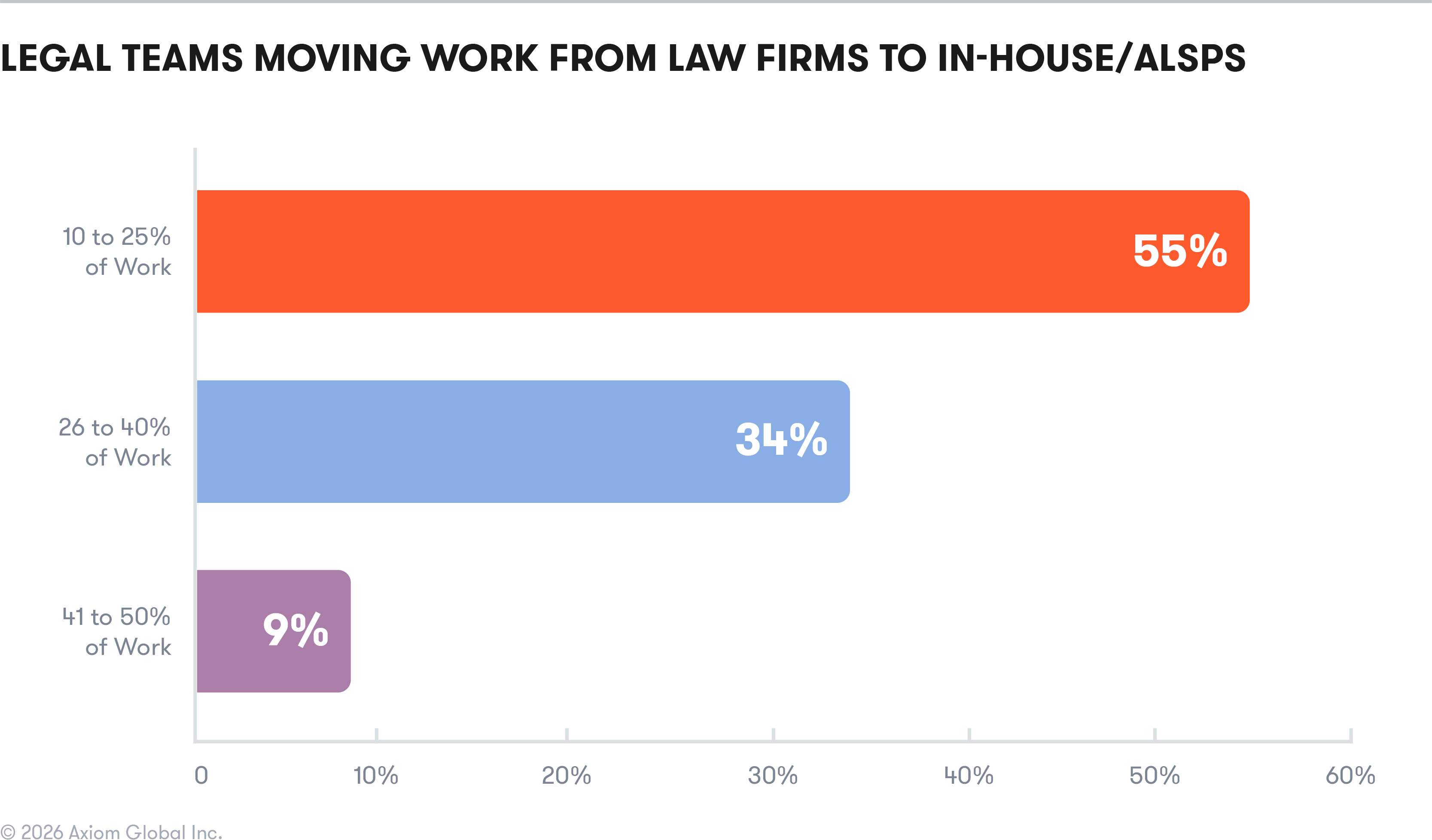
Nearly All In-House Teams Are Moving Law Firm Work In-House
When we asked how much law firm work departments plan to shift in-house or to alternative providers, the scale of the coming change became clear. Over half of in-house teams will move between 10 and 25% of law firm work in-house or to alternative legal service providers (ALSPs) in the next 12-24 months. Another third of respondents will move between 26 and 40% of that work back in-house or to ALSPs. And nearly one in ten legal departments will shift between 41 and 50% of law firm work in-house or to alternative providers.
And this isn’t about secondments, gap fills, or maternity coverage. We’re talking about strategic legal work requiring high-quality output from elite lawyers—work that’s increasingly being scaled with AI.

The Satisfaction Gap
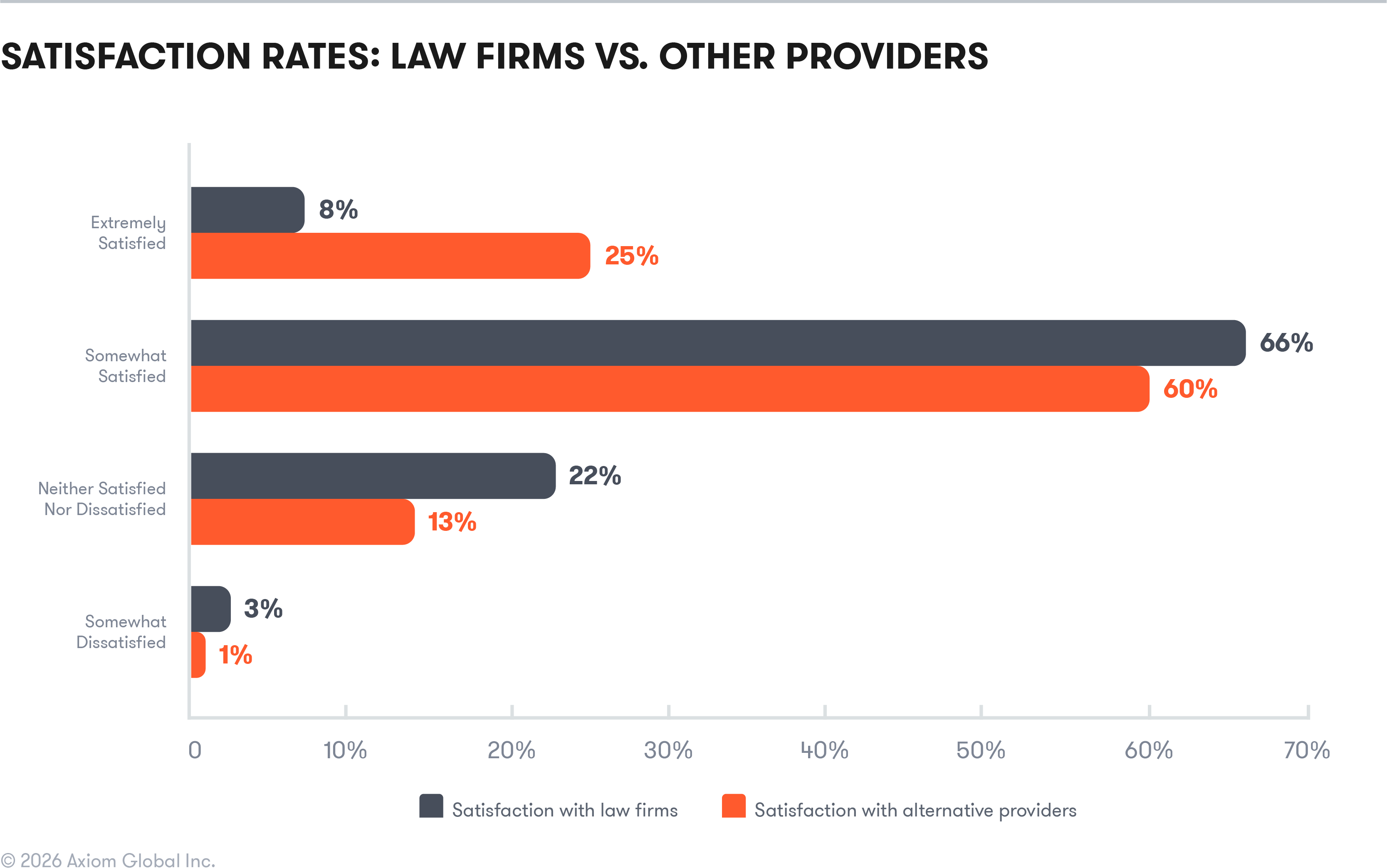
Perhaps the most revealing finding: In-house teams are three times more likely to report extreme satisfaction with alternative legal service providers than with law firms.
When we asked about satisfaction levels, a quarter of respondents said they were “extremely satisfied” with alternative legal services, compared to just 8% for law firms. Combined satisfaction scores remain high for both, with 85% for ALSPs versus 74% for law firms, but the intensity of satisfaction tells a different story. Our hypothesis? Similar or superior talent quality at a far lower cost drives higher extreme satisfaction with alternative providers.
Two-thirds of in-house leaders now see ALSPs as an equal alternative to law firms for day-to-day strategic legal work. Yet paradoxically, more than half continue reflexively using law firms as a relief valve rather than engaging strategically with alternatives.
Change takes courage.
Figure 2
The AI “No Man’s Land”
The research also uncovered a critical challenge facing legal departments: AI adoption is nearly universal at 96%, yet only 31% of teams are using it at scale.
Two-thirds of teams are stuck in pilot purgatory—caught between adoption and transformation. The biggest barrier? Nearly half of in-house team leaders report feeling bewildered by the number of AI providers and options available. Multi-year contracts with AI vendors emerged as the second-biggest barrier to progress, reflecting concerns about being locked in and potentially left behind by rapidly advancing technology.
Teams need partners who can help them navigate this rapidly evolving landscape and get the best out of AI, rather than locking them into long-term commitments that risk obsolescence.
Accelerate progress with top-tier legal talent equipped with vetted AI tools—no long-term lock‑in.
Are We Crossing the Rubicon?
The full 2026 GC Report: Beyond the Billable Hour digs deeper into the budget contradiction, exploring why bigger budgets aren’t solving the efficiency problem and where in-house leaders say they’d actually cut spending to get better results. We’ll also present the 2027 Readiness Test, revealing what separates legal departments that will thrive from those that will struggle. The complete report will include regional breakdowns, comprehensive data analysis, and strategic guidance for navigating this threshold moment.
The question isn’t whether the partnership model and hourly billing will survive. The question is whether we’re crossing the Rubicon to a world where in-house legal leaders reserve law firms for “bet the company” work, and for everything else, empower their teams with AI-enabled alternatives.
Get the Full Report