



New research reveals a troubling dynamic: 79% of law firms use AI to boost efficiency, but only 6% pass those savings to clients—while 34% actually charge premium rates for AI-enhanced work.
The promise of artificial intelligence in legal services was supposed to benefit everyone: law firms would work more efficiently, clients would pay less for faster results, and the entire legal industry would become more accessible and cost-effective. But new research from Axiom reveals a stark reality that turns this narrative on its head.
According to our comprehensive study of 600+ senior legal leaders across eight countries, nearly four out of five law firms (79%) are actively using AI tools in their practices. Yet instead of passing the substantial efficiency gains to their clients, the vast majority are pocketing the savings—and in many cases, charging even more for AI-enhanced work.
The Numbers Don’t Lie
The findings paint a troubling picture of how AI’s productivity revolution is playing out in legal services:
- 79% of law firms are actively using AI tools
- Only 6% of law firms are charging less for AI-assisted work
- 34% of law firms are actually charging more for AI-enhanced services
- 58% of law firms have not reduced their rates despite AI assistance
This data comes at a time when law firm billing rates are already reaching unprecedented heights. Senior partners at elite law firms are approaching $3,000 per hour, with some top partners already billing at $2,720 hourly, while first-year associates are being billed at nearly $1,000 per hour at several major firms.
.png?width=1356&height=416&name=image%20(15).png)
When Efficiency Meets Economics
The disconnect between AI’s efficiency gains and client pricing reflects a fundamental shift in how legal services are being monetized. AI tools can dramatically reduce the time required for tasks like document review, legal research, contract analysis, and brief writing—work that traditionally generated substantial billable hours.
Yet rather than viewing these efficiency gains as an opportunity to provide better value to clients, many law firms appear to be treating AI as a profit multiplier. The technology allows them to complete work faster while maintaining—or even increasing—their billing rates.

The In-House Perspective
From the perspective of corporate legal departments (the clients paying these bills), the situation creates a cruel irony. They’re being asked to fund their outside counsel’s AI transformation while seeing none of the financial benefits.
This dynamic is particularly challenging given the broader economic pressures facing corporate legal departments. Many are being asked to freeze or reduce budgets, delay new hires, and find ways to do more with less. Meanwhile, law firm revenue jumped 13% in 2024, fueling a profit surge with net income rising 17%.
The research reveals that in-house legal teams are caught in a squeeze: they need legal expertise to navigate an increasingly complex regulatory and business environment, but their traditional go-to solution—engaging outside counsel—has become prohibitively expensive for all but the most critical matters.
💡 See how you can reduce your outside counsel spend.
The Innovation Imperative
These findings underscore why developing internal AI capabilities has become essential for corporate legal departments. When outside counsel benefits from AI efficiencies without sharing cost savings, in-house teams must build their own AI competencies to capture those benefits directly.
The research shows that this realization is already driving behavior change. A remarkable 94% of in-house leaders expressed interest in alternative legal service models that combine flexible AI talent with rigorously vetted legal AI tools—allowing them to access AI benefits without the premium pricing of traditional law firms.
AI Benefits Without the Premium Pricing
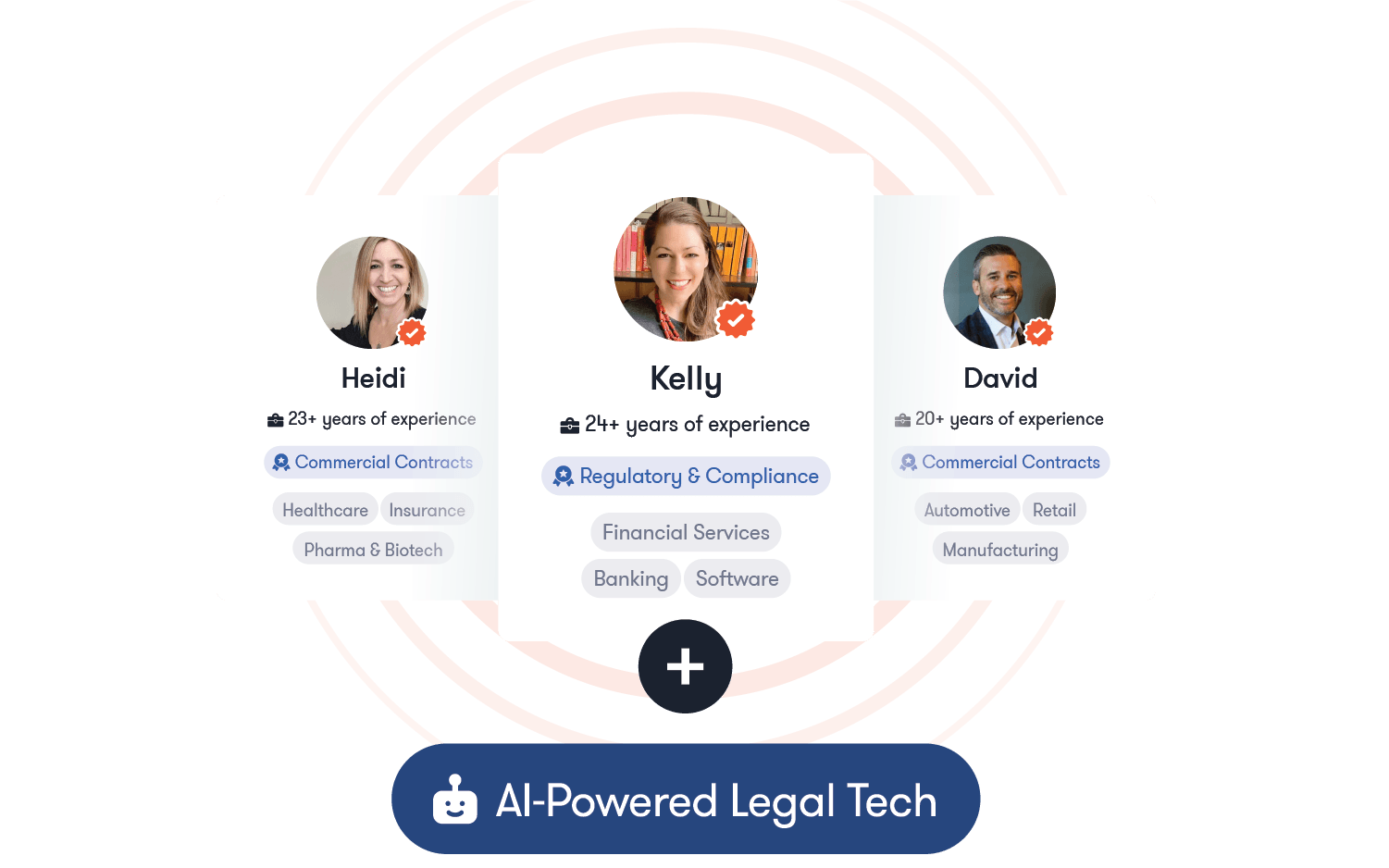
Axiom handles the research, vetting, training, and deployment of top-tier AI tools and legal talent—so you can start seeing value from day one.
- Legal talent equipped with rigorously tested AI tools.
- Managed training and onboarding.
- No long-term licensing or complex integrations.
Regional and Competitive Dynamics
The AI adoption patterns vary significantly by geography, with some regions seeing more aggressive investment than others. This creates both opportunities and risks for in-house departments depending on their market dynamics and competitive pressures.
A Market Correction in the Making?
The current dynamic may not be sustainable long-term. As in-house legal departments become more sophisticated in their AI procurement and deployment, they may reduce their dependency on outside counsel for routine work that can be handled efficiently with AI assistance internally.
The research shows this realization is already driving interest in alternative legal service models that combine flexible AI talent with rigorously vetted legal AI tools.
Responses Tempered by New Realities
For corporate legal departments, the research suggests several strategic responses:
- Build Internal AI Capabilities: Rather than paying premium rates for outside counsel’s AI efficiencies, develop internal capabilities to capture those benefits directly.
- Demand Transparency: When engaging outside counsel, require clear disclosure of AI usage and negotiate pricing that reflects the actual resource requirements for AI-assisted work.
- Explore Alternatives: Consider flexible legal talent models that combine AI tools with experienced practitioners (with more transparent pricing structures).
- Benchmark and Negotiate: Use data on AI efficiency gains to inform rate negotiations and challenge premium pricing for AI-enhanced work.
The Bottom Line
The legal industry stands at an inflection point. AI has the potential to make legal services more efficient, accessible, and cost-effective. But realizing that potential requires a more equitable distribution of AI’s benefits between providers and clients.
The current model, where law firms capture AI efficiency gains while clients pay the same or higher rates, represents a missed opportunity for the entire legal ecosystem. Corporate legal departments that develop their own AI strategies will be better positioned to control costs, improve efficiency, and avoid being locked into this unfavorable dynamic.
The research makes clear that the AI revolution in legal services is happening with or without traditional law firms passing benefits to their clients. The question for corporate legal departments is whether they’ll be passive recipients of AI-enhanced bills or active participants in capturing AI’s value for their organizations.