



New research reveals the specific behaviors and strategies that distinguish AI-mature legal departments—and why geography and size matter more than you think.
The legal profession's AI transformation isn't happening uniformly—it's creating distinct tiers of capability that could become impossible to bridge once fully established. Our latest Legal AI research report with 600+ senior legal leaders reveals not just who's ahead, but how they got there and what it means for everyone else.
While our preview post on this research highlighted the overall AI divide, this deeper examination exposes the specific organizational DNA that separates truly mature AI adopters from those still struggling to move beyond experimentation. The insights are both encouraging and sobering: there are clear paths to AI maturity, but the window for catching up is closing faster than many realize.
Defining AI Maturity: Beyond Just “Using AI”
Most legal departments think they're making AI progress because they've started using ChatGPT or signed up for Copilot. Our research reveals this assumption is dangerously misleading. True AI maturity isn't about tool adoption—it's about strategic integration across three critical dimensions:
Access + Usage + Strategic Implementation = AI Maturity
We categorized legal departments into three distinct maturity levels:
- Mature (21%): Comprehensive access with high regular usage rates and strategic deployment across multiple legal functions
- Developing (66%): Broad access but inconsistent implementation, often fragmented across the organization
- Immature (13%): Significant access barriers with minimal actual usage, mostly in research phases

The most revealing finding? Access alone means nothing. Some departments with enterprise-wide AI access remain functionally immature because they lack the organizational capabilities to leverage these tools effectively.
💡 Move from AI access to maturity with AI-enabled legal talent.
The Geography of AI Leadership
The global AI maturity landscape reveals stark regional differences:
The Leaders:
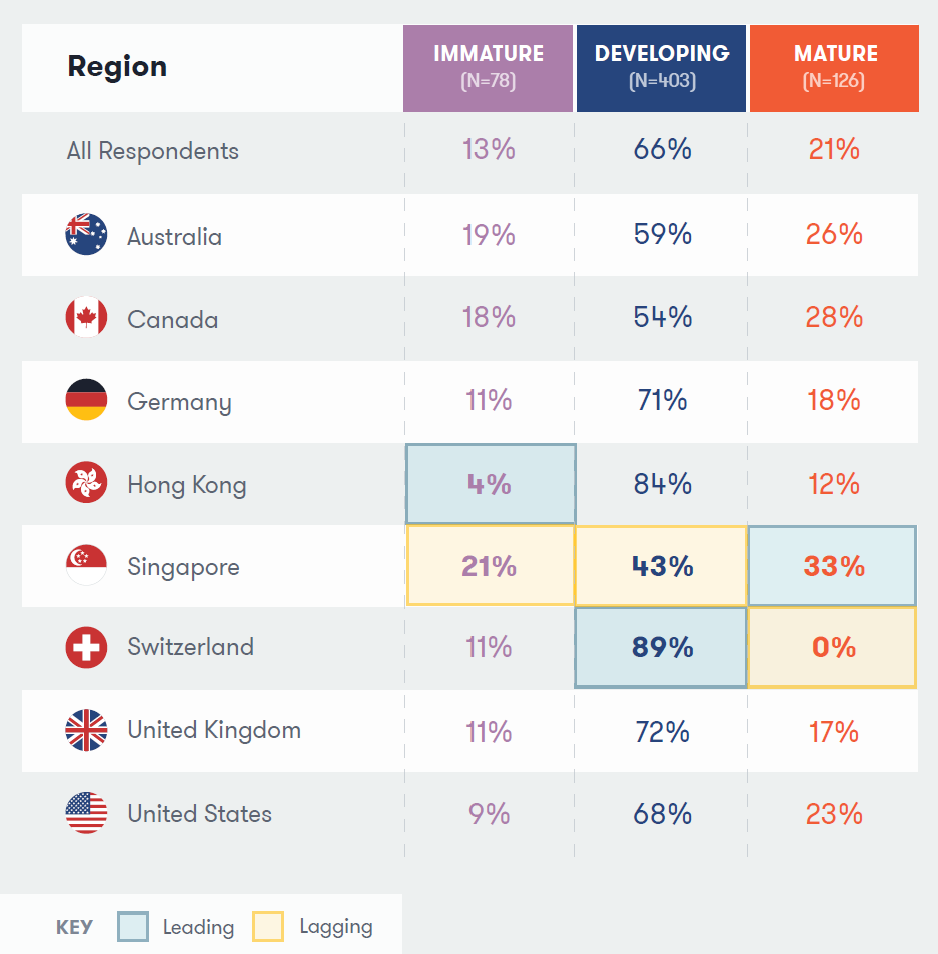
- Singapore: 33% mature –– The highest maturity rate globally
- Canada: 28% mature –– Second-highest adoption rate
- Australia: 26% mature –– Strong performance in the Asia-Pacific region
The Middle Tier:
- United States: 23% mature –– Moderate performance despite large legal technology market
- Germany: 18% mature –– Below-average maturity rates
- United Kingdom: 17% mature –– Similar performance to Germany
The Outlier:
- Switzerland: 0% mature –– No legal departments achieved mature status in the survey
Some regions are going all-in: Hong Kong leads with 95% of legal teams increasing budgets, while the U.S. and Australia aren't far behind. But others are moving more cautiously, perhaps dangerously so. Switzerland's conservative 51% budget increase suggests some legal departments may be underestimating the competitive threat.

Size Matters, But Not How You'd Expect
Conventional wisdom suggests larger legal departments should lead AI adoption due to superior resources and technical capabilities. Our data reveals a more nuanced reality:
The Sweet Spot: Mid-Sized Departments (11 - 50 people)
- 56% achieve mature status - The highest rate across all size categories
- Large enough for dedicated AI initiatives, small enough to maintain agility
- 63% immature – The highest rate suggests opportunity for growth
The Laggards: Enterprise Departments (51 – 100+ people)
- Only 18% achieve maturity - Surprisingly low given resource advantages
- Bureaucratic inertia and risk-averse cultures are known to slow decision-making in large organizations
- Complex stakeholder alignment requirements likely delay implementation
The Strivers: Small Departments (1-10 people)
- 27% mature - Impressive for resource-constrained teams
- Necessity could drive innovation; limited staff may force efficiency focus
- Direct decision-making authority could accelerate adoption
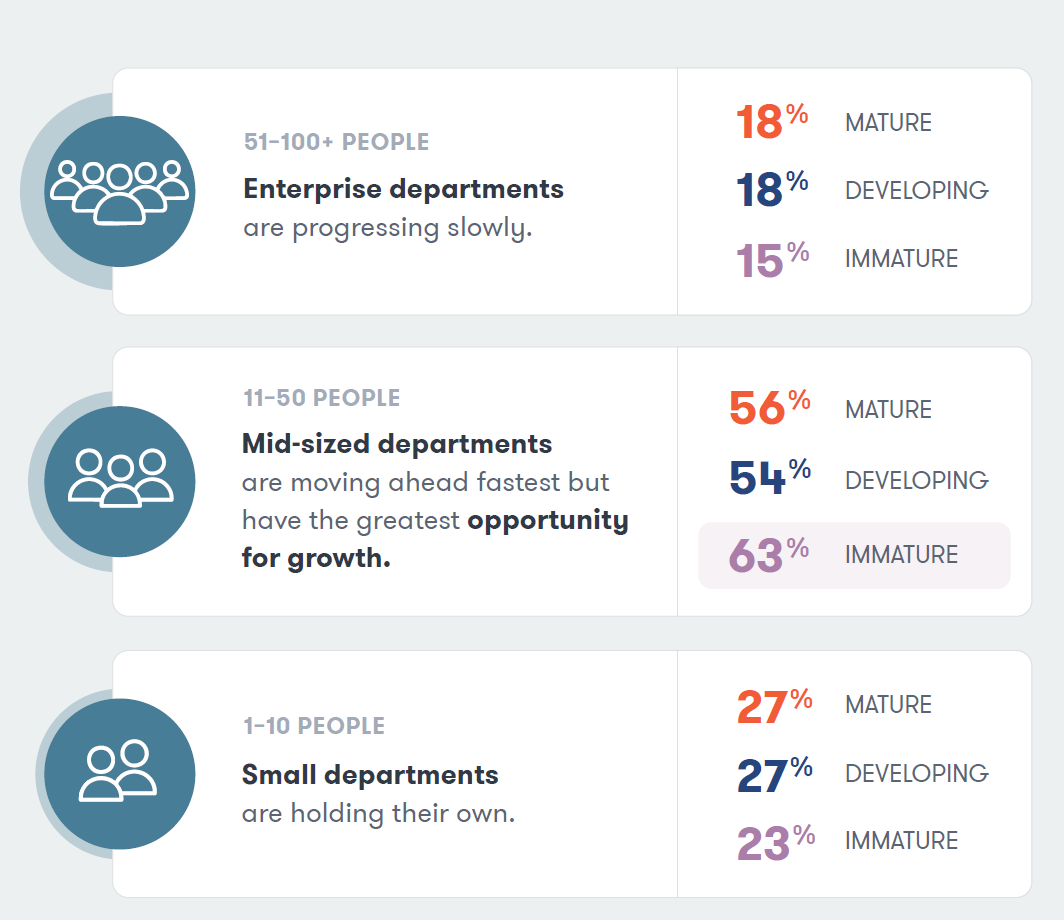
This size-maturity relationship suggests that organizational agility could often trump raw resources in AI implementation. The most successful departments share a common trait: they can move from decision to deployment quickly.
Move Faster with Tech+Talent
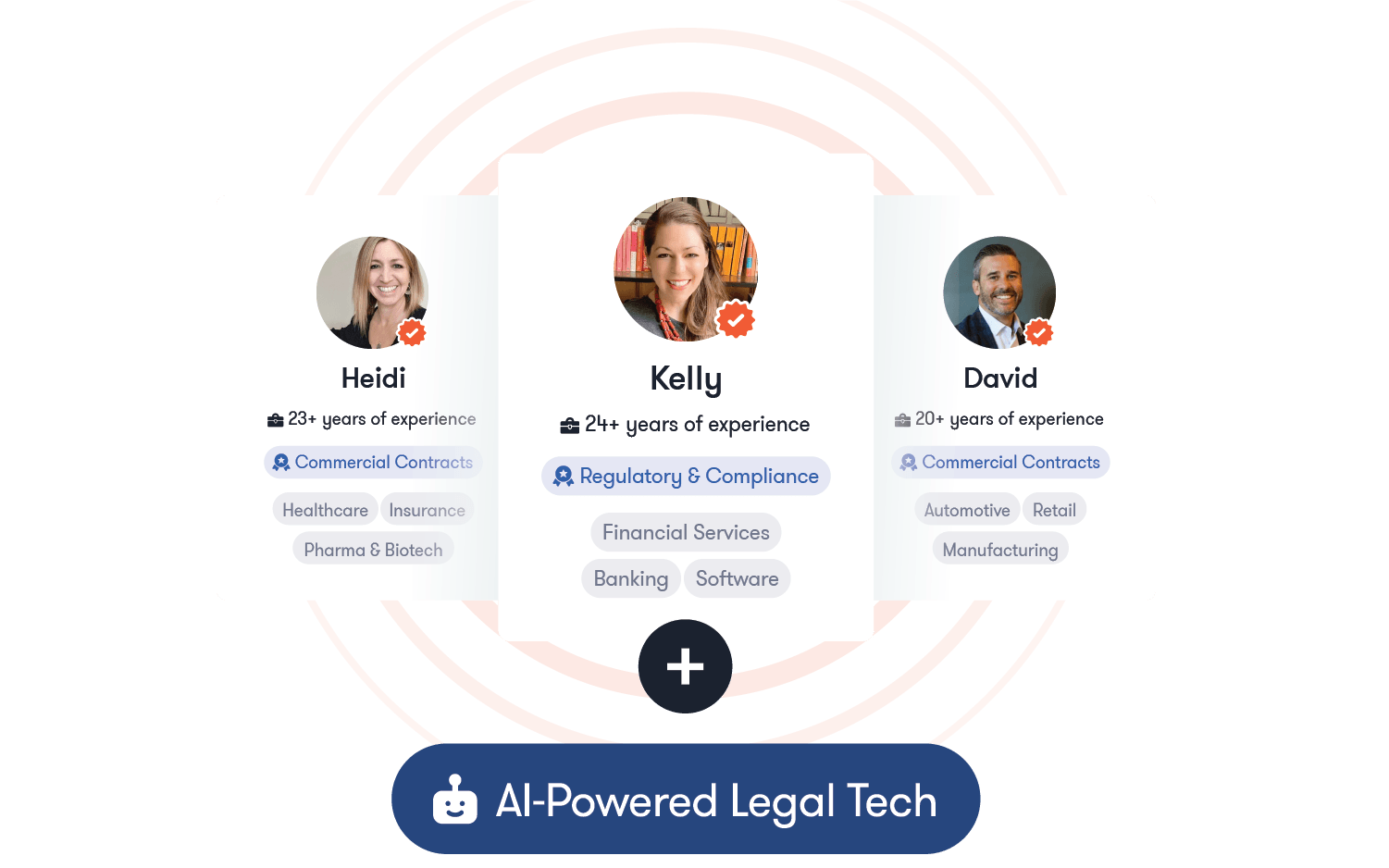
Axiom handles the research, vetting, training, and deployment of top-tier AI tools and legal talent—so you can start seeing value from day one.
- Legal talent equipped with rigorously tested AI tools.
- Managed training and onboarding.
- No long-term licensing or complex integrations.
The Procurement Blind Spot
Perhaps the most concerning finding involves how legal departments acquire AI tools. Across all maturity levels, 45% handle AI procurement entirely in-house (within the legal department)—identification, vetting, and payment—despite lacking technical expertise to evaluate complex AI systems.
Only 4% of legal departments partner with IT end-to-end for AI procurement, representing a massive missed opportunity for technical expertise and AI risk mitigation. Even mature teams show this pattern, suggesting that overconfidence could be outpacing technical competence in critical procurement decisions.
This "DIY AI" approach creates several risks:
- Security vulnerabilities from inadequately vetted tools
- Integration challenges with existing systems
- Compliance gaps in data handling and privacy
- Suboptimal tool selection based on marketing rather than capability
The Investment Reality Check
The budget data reveals the urgency behind AI adoption. While 76% of departments are increasing AI investments, the regional variations tell a deeper story:
- Hong Kong: 95% increasing budgets, 27% average increase –– Market pressure driving aggressive investment
- Switzerland: 51% increasing budgets, 9% average increase –– Conservative approach that may create competitive disadvantage
- Germany: 75% increasing budgets, 33% average increase –– Methodical but substantial commitment
These investment patterns suggest that conservative regions risk falling permanently behind as AI-mature departments compound their advantages.
The Law Firm Factor
External counsel relationships add another layer of complexity. With 79% of law firms using AI but only 6% passing savings to clients, in-house departments face a cruel irony: they must invest in AI capabilities while their outside counsel benefits from AI efficiencies without sharing cost savings.
This dynamic makes internal AI maturity even more critical. Departments that develop sophisticated AI capabilities can reduce dependence on external counsel for routine work, capturing efficiency gains directly.
The Path Forward: Learning from the Leaders
For legal departments seeking to accelerate their AI maturity, the research points to several key strategies:
- Focus on Implementation Over Access
- Don't confuse tool availability with organizational capability. Mature departments excel at systematic deployment, not just tool acquisition.
- Prioritize Governance Infrastructure
- Policies, training, and risk management frameworks enable sustainable AI adoption. Without these foundations, even sophisticated tools create more problems than they solve.
- Leverage External Expertise Strategically
- The most mature departments combine internal capabilities with external AI specialists, avoiding the procurement blind spots that plague many organizations.
- Think Regionally and Competitively
Understanding your regional competitive landscape helps calibrate the urgency of AI investment. Conservative markets may offer catching-up opportunities, while aggressive markets demand immediate action.
The Bottom Line
AI maturity in legal departments isn't about technology—it's about organizational transformation. The departments pulling ahead share common characteristics: strategic vision, systematic implementation, risk-managed experimentation, and the organizational agility to evolve quickly.