



New research finds that the biggest barrier to legal transformation isn’t money or technology. It’s mindset.
Ask most general counsel what’s holding their departments back, and they’ll point to budget. It’s a reasonable answer. And it’s probably wrong.
New data from Axiom’s 2026 GC Report: Beyond the Billable Hour, based on a survey of 516 senior in-house legal leaders across eight countries, tells a more complicated story. Legal leaders overwhelmingly know change is necessary. They can see the alternatives. They understand the math. And yet, the same entrenched patterns keep reasserting themselves—not because of money, but because of culture, risk aversion, and the gravitational pull of “the way we’ve always done it.”
That’s a change management problem. And it may be the most underappreciated challenge in legal today.
The Knowing-Doing Gap
The 2026 GC Report: Beyond the Billable Hour is full of striking contradictions. Consider this one: 61% of legal departments continue to send work to law firms simply because “we have always sent certain work to law firms.” At the same time, over 80% of those same departments plan to move certain law firm work in-house or to alternative providers within the next 24 months.
Legal leaders know what needs to happen. They’re just not doing it yet.
The same pattern plays out in the data on alternative legal service providers (ALSPs). Two-thirds of in-house leaders now see ALSPs as a genuine alternative to law firms for day-to-day strategic legal work—not just for gap fills or maternity coverage, but for substantive work previously reserved for traditional firms. Yet more than half continue reflexively routing work to law firms rather than engaging ALSPs strategically. Awareness and action remain stubbornly disconnected.
What’s Actually in the Way
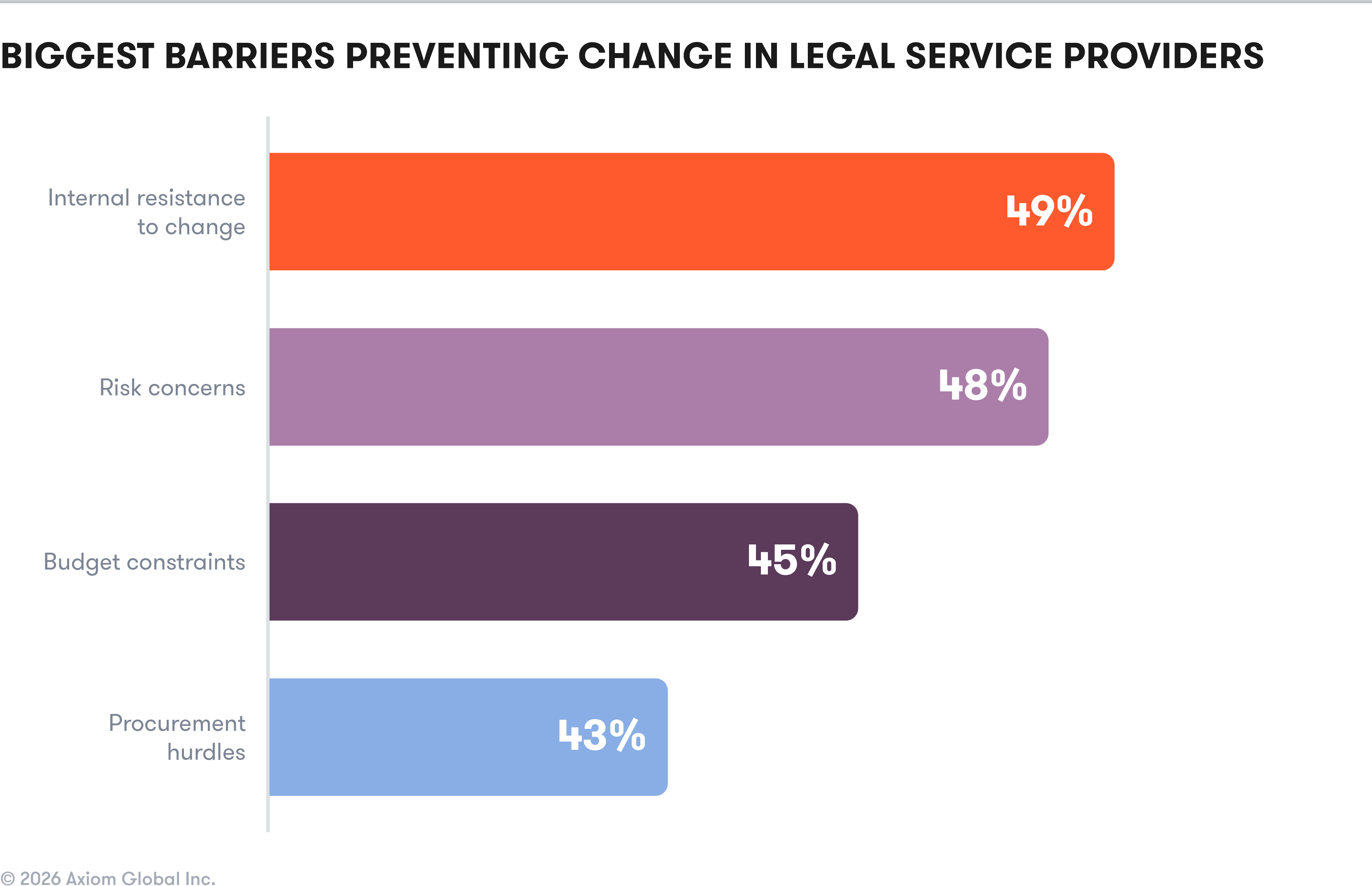
When we asked legal leaders what prevents their departments from making changes they believe would be beneficial, the answers were revealing. Internal resistance to change topped the list at 49%, followed by risk concerns at 48%. Budget constraints came in third at 45%, and procurement hurdles came in fourth at 43%.
That’s worth pausing on. Cultural and risk-related barriers outrank financial and procedural ones. The obstacle isn’t primarily that leaders lack the resources to change; it’s that the human and organizational dynamics make change feel dangerous.
Figure 1
When we asked a follow-up free-text question: “If you could remove one obstacle preventing you from making changes within your legal department, what would you remove?” the responses reinforced this picture. Cultural resistance and technology/legacy systems tied at 25% each as the single most important barrier respondents would eliminate. Leadership bottlenecks came in at 15%, organizational silos at 11%, and process/workflow issues at 10%.
Half of in-house legal leaders, when pressed to identify their number one impediments, named something that has nothing to do with headcount or budget lines. They named the invisible architecture of habit, hierarchy, and fear.
The Cost of Inertia
None of this would matter much if the status quo were working. But the data makes clear it isn’t.
Four in five in-house leaders say law firm rates are too high, with 80% rating their firms between six and nine on a scale where five is “just right” and 10 is “too high to justify.” Despite this, only 5% say their firms are appropriately priced. Meanwhile, satisfaction data reveals a striking gap: In-house teams are three times more likely to report extreme satisfaction with alternative legal service providers than with traditional law firms, with 25% report being “extremely satisfied” with ALSPs versus just 8% for law firms.
The departments that stay on the current path are paying more and, according to their own assessments, getting less. The cost of inertia is real and measurable.
At the same time, 90% of departments report continuing pressure to improve efficiency, even though two-thirds received budget increases in their most recent cycles, averaging 12%. Bigger budgets haven’t quieted the efficiency imperative. If anything, they’ve intensified it, as executives expect more for every dollar spent. With 56% of legal departments reporting a likelihood of headcount freezes or reductions in 2026, the math grows harder still.
Staying the course is not a neutral choice. It is an active decision to accept a cost structure and satisfaction profile that most in-house leaders already know they can’t defend.
Why Change Is Hard Even When Leaders Want It
Understanding why smart, motivated legal leaders fail to execute on changes they believe in requires empathy, not just analysis.
Legal departments operate within larger organizations that have their own risk tolerances, procurement processes, and institutional memories. A GC who wants to shift work to an ALSP still has to get procurement to onboard a new vendor, manage concerns from the C-suite about departing from established outside counsel relationships, and navigate the very human reality that longtime law firm partners have advocates inside the building.
Risk aversion is also rational in legal contexts. The legal function is one where mistakes carry asymmetric consequences. A bad outcome on a significant matter creates far more organizational pain than any cost savings could offset. When the downside of change feels larger than the upside, people stay put.
And technology adds its own layer of paralysis. The report finds that nearly half of legal leaders feel overwhelmed by the number of AI providers available, while a third cite multi-year vendor contracts as a significant barrier to progress. In this environment, change doesn’t just require organizational will; it requires navigating a complex market without clear signposts.
Don’t choose between caution and progress. Axiom's model creates room for both.
What Best-in-Class Departments Do Differently
The research also asked respondents to look ahead and rank the capabilities that will distinguish best-in-class legal departments in 2027. The top five: AI and technology expertise, empowerment of in-house talent, data analytics enabling performance KPIs, an innovation mindset, and agile resourcing models.
Figure 2
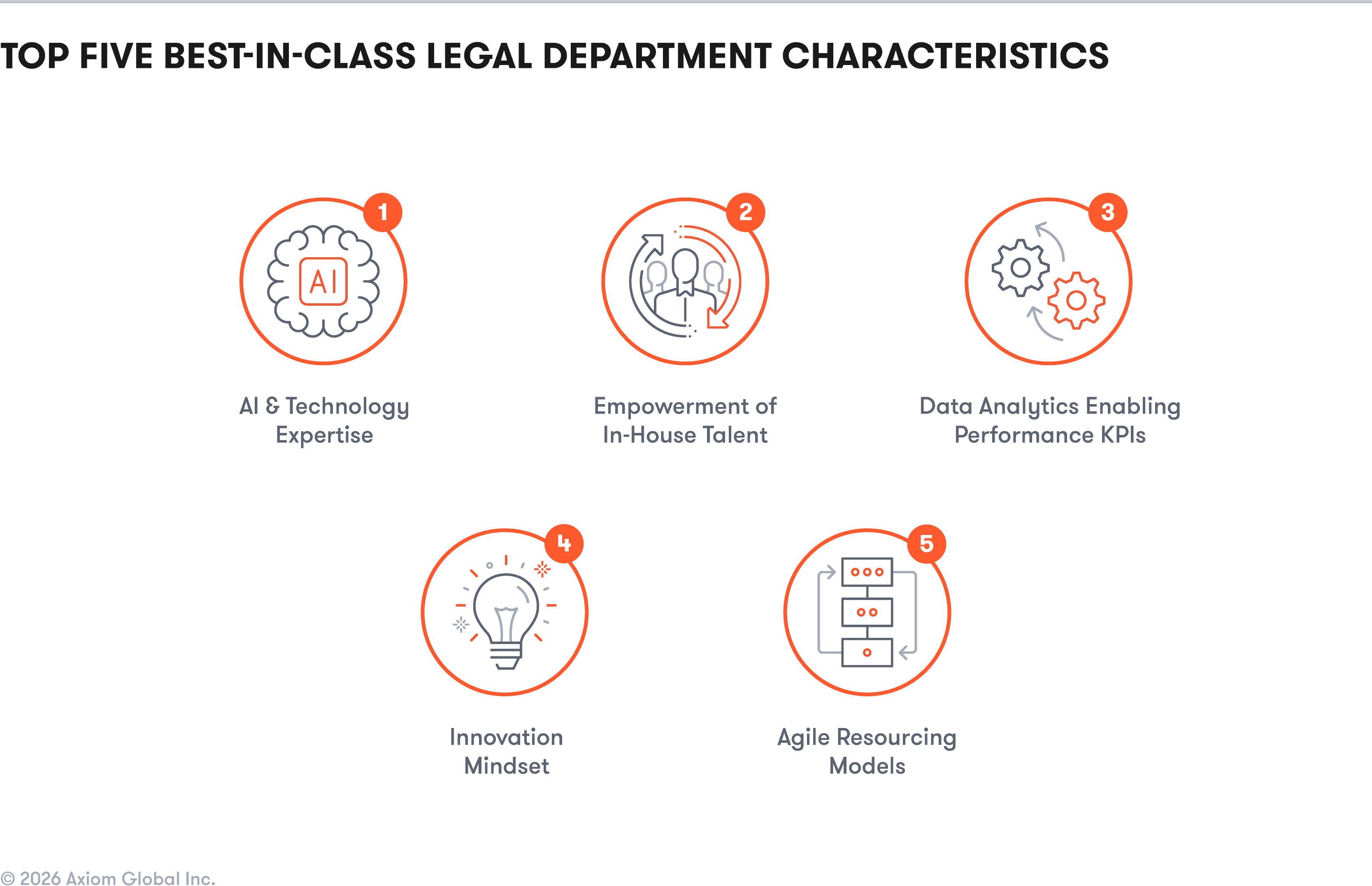
What’s notable about this list is how much it reflects organizational culture rather than technical investment. Empowerment of in-house talent. Innovation mindset. Agile resourcing. These aren’t line items in a budget; they’re the outputs of leadership choices about how a department is structured, how decisions get made, and how risk is evaluated.
The departments that will thrive in 2027 are the ones making those choices now. Not after the next budget cycle. Not after the AI landscape “settles down.” Now.
Change Starts With an Honest Audit
The 2026 GC Report: Beyond the Billable Hour points toward a practical first step: Take a clear-eyed look at what is actually being sent to law firms and why. For the 61% of departments routing work to outside counsel out of habit, that audit alone may be revealing. Some of that work genuinely requires the depth and expertise of a top-tier firm. A significant portion probably doesn’t.
The next question is whether that work could be handled through AI tools, an ALSP equipped with elite legal talent, or a combination of the two. Increasingly, the answer is yes—and at rates up to 50% less than traditional law firms.
That’s not a future possibility. It’s the current reality that two-thirds of legal leaders already recognize, even as many haven’t yet acted on it.
The knowing-doing gap is real. But it is also closeable. And the legal leaders who close it first will have a meaningful head start on the departments still waiting for permission to change.