



The phrase “legal technology” gets used constantly in legal circles right now, and for good reason. In-house legal teams are continually under increasing pressure to do more work with fewer resources, move faster, and demonstrate measurable value to the business. And technology is increasingly central to how forward-thinking legal departments are responding to all three of those demands.
But what does legal tech actually include? Which categories matter most for in-house teams? And how do you cut through the noise to figure out what legal tech is actually worth your attention?
This guide covers the fundamentals: what legal technology is, what it does, why it matters for in-house counsel specifically, and how to think about bringing it into your legal department.
What Is Legal Tech?
Legal technology refers to software, tools, and digital platforms designed to support, streamline, or automate legal work. The category is broad, ranging from basic document storage and matter tracking to AI-powered contract review and predictive analytics.
For in-house legal teams, legal tech is less about replacing legal judgment and more about removing the friction that surrounds it. The goal is to get lawyers out of administrative tasks, reduce the time spent on repetitive work, and free up capacity for the work that actually requires a trained legal mind.
The market has grown substantially as that value proposition has become clearer. In 2024, the global legal technology market was estimated at over $26 billion and is projected to reach nearly $47 billion by 2030, growing at a compound annual growth rate above 10%. That growth reflects real investment by real organizations, many of them in-house legal departments facing the same resource pressures as yours.
Why Legal Tech Matters for In-House Teams Right Now
The business case for legal technology has never been stronger, in part because the alternative has never looked more expensive.
According to the 2024 ACC Chief Legal Officers Survey, 42% of in-house legal departments received a mandate to cut legal costs, while 58% saw significant rate increases from their outside counsel. At the same time, 59% of CLOs reported their workloads increased over the previous year. That combination of rising costs, shrinking budgets, and growing volume is precisely the environment where legal technology earns its place.
The same survey found that 45% of CLOs planned to invest in new technology in direct response to efficiency pressures . And the 2025 CLO Survey found that 44% of legal departments, particularly in large companies, are actively implementing new legal technology, with contract management ranking as the top technology priority at 62%.
This isn't a trend legal departments are chasing because it sounds innovative. The underlying pressure is real, and the tools that existed five years ago weren't built to absorb it.
The Benefits of Investing in Legal Technology
The strongest case for investing in legal technology is straightforward: it changes what your team can accomplish with the same number of people.
Speed: AI-powered tools can dramatically compress the time required for high-volume, repetitive tasks. Contract review, legal research, document summarization, and first-draft generation all run faster when supported by the right technology. That speed compounds across a legal department's portfolio of work.
Consistency and accuracy: One of the less obvious benefits of legal technology is standardization. When AI tools apply the same playbook logic across every contract in a review, you reduce the variability that comes with different reviewers working under different time pressures. The quality floor goes up.
Risk management: Legal tech tools built for document management, compliance tracking, and contract lifecycle management give legal teams better visibility into where exposure exists across the organization. Fewer things slip through the cracks when the systems supporting your work are designed to catch them.
Cost control: Technology enables in-house teams to handle work internally that might otherwise go to outside counsel at a significantly higher cost. It also gives legal operations leaders better visibility into spend, matter volume, and resource allocation across the department.
Strategic repositioning: When routine tasks are handled more efficiently, lawyers spend more time on the work that actually requires senior legal judgment. That shift matters for how legal departments are perceived internally. Teams that can demonstrate they are velocity drivers, not bottlenecks, tend to earn more credibility with the C-suite.
Types of Legal Tech: Key Categories for In-House Teams
The legal tech landscape includes dozens of product categories. For in-house counsel, the most relevant ones tend to cluster around a few core functions.
Legal Research Tools
Legal research platforms have been part of the legal workflow for decades, but AI-powered features have changed what they can do. Modern research tools use natural language processing to surface relevant case law, statutes, and secondary sources faster and with better contextual precision than traditional keyword search. For in-house teams that need to answer regulatory questions, assess litigation risk, or stay current on evolving legal standards, these tools reduce the time it takes to get to a defensible answer.
Document Automation
Document automation software allows legal teams to generate standard legal documents (think NDAs, employment agreements, IT vendor contracts, and similar instruments) from pre-approved templates without starting from scratch each time. The practical benefit for in-house teams is significant; instead of a lawyer spending an hour drafting a routine agreement, the tool handles the first pass based on defined parameters, and the lawyer reviews and adjusts as needed. This is particularly valuable for legal departments that support high-volume commercial activity.
Contract Review and Contract Lifecycle Management (CLM)
Contract review tools use AI to analyze incoming third-party paper, flag deviations from standard positions, and suggest redlines with explanatory justification. Contract lifecycle management platforms take a broader view, tracking contracts from initiation through execution, renewal, and expiration. For in-house legal teams managing large contract portfolios, CLM systems provide the visibility and data layer needed to actually understand what commitments the organization has made. And interestingly, contract lifecycle management is currently the fastest-growing segment in the legal tech market.
Matter Management and Practice Management
Matter management systems are the operational backbone of a well-run legal department. They track active matters, deadlines, assigned resources, and associated costs across the team's full portfolio of legal work. For GCs managing a team, matter management software replaces spreadsheets and manual tracking with a real-time view of what the department is working on, where things stand, and how resources are allocated. Practice management tools designed for law firms serve a similar purpose but are typically built around billing and client management in addition to matter tracking.
E-Discovery and Document Review
E-discovery platforms are designed to handle the collection, processing, and review of large volumes of electronically stored information in the context of litigation, investigations, or regulatory proceedings. AI-assisted document review has materially changed what’s possible, reducing the time and cost required to process large document sets while improving consistency. For in-house teams that manage significant litigation exposure or operate in heavily regulated industries, this category has high practical relevance.
Generative AI Tools
Generative AI represents the most significant recent shift in the legal tech landscape. These tools can draft, summarize, analyze, and research with a level of contextual sophistication that earlier software couldn't approach. According to the Thomson Reuters 2025 Generative AI in Professional Services Report, 26% of legal organizations were actively using generative AI as of early 2025, nearly double the adoption rate from a year earlier. Document review (77%), legal research (74%), and document summarization (74%) were the most common use cases among legal professionals. And 78% of respondents expected generative AI to become central to their workflows within five years.
The adoption curve is real, and so are the implementation challenges. More on that below.
Collaboration Tools and Cloud-Based Platforms
Cloud-based legal platforms have changed how legal teams manage information, collaborate with internal stakeholders, and work with outside counsel. Secure document sharing, real-time collaboration, and centralized matter information reduce the friction of working across multiple offices, business units, or external relationships. Cloud-based solutions captured roughly two-thirds of the legal technology market in 2024, according to Mordor Intelligence, driven by the combination of lower capital costs, remote accessibility, and faster deployment compared to alternatives.
How In-House Legal Teams Use Legal Technology
The way in-house legal departments actually deploy legal technology looks different from how law firms use it. The priorities are different, the resource constraints are different, and the measures of success are different.
For in-house teams, the highest-value applications tend to concentrate in a few areas.
Contract work is the most common starting point. Whether it's AI-powered contract review for incoming third-party paper, automation for standard outbound agreements, or CLM for portfolio management, contracts represent the highest-volume, most recurring legal workflow for most in-house departments. Efficiency gains here have an immediate operational impact.
Legal research is a close second. Being able to turn around accurate regulatory analysis, case law research, or compliance assessments faster has direct downstream effects on the business functions legal teams support.
Legal operations professionals are increasingly using technology for spend analytics, matter management, and reporting, building the data infrastructure that allows legal to demonstrate its value to the business in quantifiable terms. According to the 2025 ACC CLO Survey, 96% of CLOs and legal operations leaders agreed that generative AI can help them better prove their strategic value to the business.
Finally, e-discovery and document management matter most for teams that handle significant litigation exposure or operate in heavily regulated industries. The volume and cost implications of managing large document sets without purpose-built tools are significant.
Pair tech with experienced operational leadership to optimize spend, workflows, and performance.
How to Implement Legal Technology in Your Department
Buying a legal technology tool and actually getting value from it are two very different things. Most implementations that fall short do so not because the technology was wrong but because the deployment was lacking.
Start with a specific problem, not a general capability. The most successful legal tech implementations begin with a clear articulation of the workflow problem being solved. Which tasks are taking too long? Where are errors coming from? What work is going outside because the internal team doesn't have bandwidth? Those answers should drive tool selection, not the other way around.
Vet tools against real work, not demos. Demos are designed to show tools at their best. That means the only reliable test is performance on your actual contract types, your playbooks, and your workflows. A structured pilot with a narrow scope—like one contract type, one team, and a defined timeframe—generates data that a demo never can.
Take data security seriously from the start. Any platform handling sensitive legal documents needs to meet rigorous security standards. Confirm data governance policies, determine whether client data is used to train models, and verify relevant certifications before you move forward. This is a prerequisite, not a nice-to-have.
Don't skip training. One of the most common reasons legal tech implementations stall is the assumption that qualified professionals will figure out how to use a new tool on their own. They often don't, or they do it slowly and inconsistently. Adoption requires deliberate onboarding, clear guidance on where the tool fits in the workflow, and visible support from leadership.
Measure what matters. Define success metrics before you deploy. Time to first draft, cycle time for standard agreements, volume of contracts processed, and cost per matter are the kinds of numbers that let you assess whether a tool is delivering real value and make the case to finance when it does.
Consider pairing tools with trained talent. Technology works best when the people using it know how to extract value from it. If your team doesn't have the bandwidth to evaluate the market, run structured pilots, and onboard a new tool, working with a partner who has already done that work can significantly accelerate time to value.
Legal Tech FAQ
What is legal tech?
Legal tech is the broad category of software and digital tools designed to support legal work. It includes everything from cloud-based document management systems to AI-powered contract review platforms. For in-house legal teams, the most relevant legal technology is whatever reduces time spent on repetitive, high-volume tasks so lawyers can focus on the work that requires senior legal judgment.
What does legal technology include?
Legal technology includes tools across a wide range of legal workflows: legal research platforms, document automation software, contract review and contract lifecycle management tools, matter management systems, e-discovery platforms, e-billing software, compliance tracking tools, and generative AI applications for drafting, summarization, and analysis. The category continues to expand as AI capabilities improve.
What are examples of legal tech tools?
Common examples include tools for legal research, contract lifecycle management, e-discovery, and a range of AI-native tools for contract review and document drafting. Generative AI platforms are increasingly being piloted by both law firms and in-house teams for research, drafting, and analysis workflows.

How is legal tech used in law firms and in-house legal teams?
Law firms tend to prioritize legal technology that supports client delivery, particularly in research, drafting, and litigation support. In-house legal teams focus more on the operational side: contract management, legal spend analytics, matter tracking, and document automation for high-volume commercial work. The business model is different, so the technology priorities differ accordingly. In-house teams also tend to have tighter budgets and fewer dedicated legal technology resources, which shapes how implementations get structured.
What problems does legal tech solve?
The core problems legal technology addresses are speed, consistency, cost, and capacity. Legal departments face persistent pressure to process more work with the same or fewer people, while demonstrating that the legal function adds measurable value to the business. Technology helps on all four dimensions: it compresses the time required for routine tasks, applies standards consistently across large volumes of work, reduces the cost of handling repetitive work internally, and expands what a team can accomplish without adding headcount.
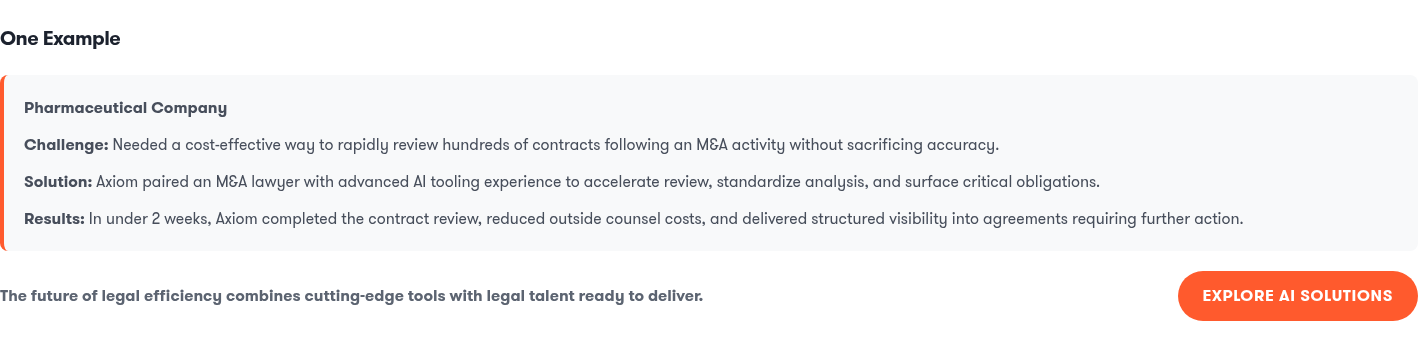
See how legal teams use tech-enabled talent to accelerate work, cut costs, and expand capacity.
Working with Axiom on Legal Tech Adoption
Evaluating the legal technology market, running structured pilots, and getting your team up to speed on new tools takes time that most in-house legal departments don't have. Axiom's Tech+Talent solution is built for exactly that challenge. Axiom has assessed more than 50 legal tech tools, conducted rigorous pilot testing with in-house legal teams, and continues to monitor the market so you don't have to.
The result is a turnkey model: vetted AI tools paired with trained legal talent who already know how to use them, managed by Axiom from onboarding through delivery. If you're thinking about where legal technology fits in your department's roadmap, we'd be glad to talk through it.