


Everyone is Using AI - Now What? Key Takeaways for Drafting Effective AI Policies
June 2024
By
Kelsey Provow
As artificial intelligence (AI) rapidly becomes a ubiquitous presence in organizations across industries, legal professionals are faced with the complex challenge of drafting policies that foster innovation while mitigating legal and ethical risks.
In the recent webinar, "Everyone is Using AI - Now What?" hosted by Axiom, a panel of legal experts shared valuable insights on best practices for AI policy drafting. The panelists included:
- Zoila Mana Harpin, Former Partner at Axiom Advice and Counsel
- Anita Padmanabhan, Privacy and Commercial Counsel at Axiom
- Phillip Wolf, Global Data Protection Council Product and Policy at Palantir
What did the webinar reveal? Five key takeaways:
- The growing importance of AI governance
- Leveraging existing privacy frameworks
- Engaging stakeholders across the organization
- Balancing innovation and risk mitigation
- Adopting a practical approach
Looking for more educational resources on AI in legal ops? Sign up for our newsletter and stay updated on new webinars, blog posts, whitepapers, and more!
The Growing Importance of AI Governance
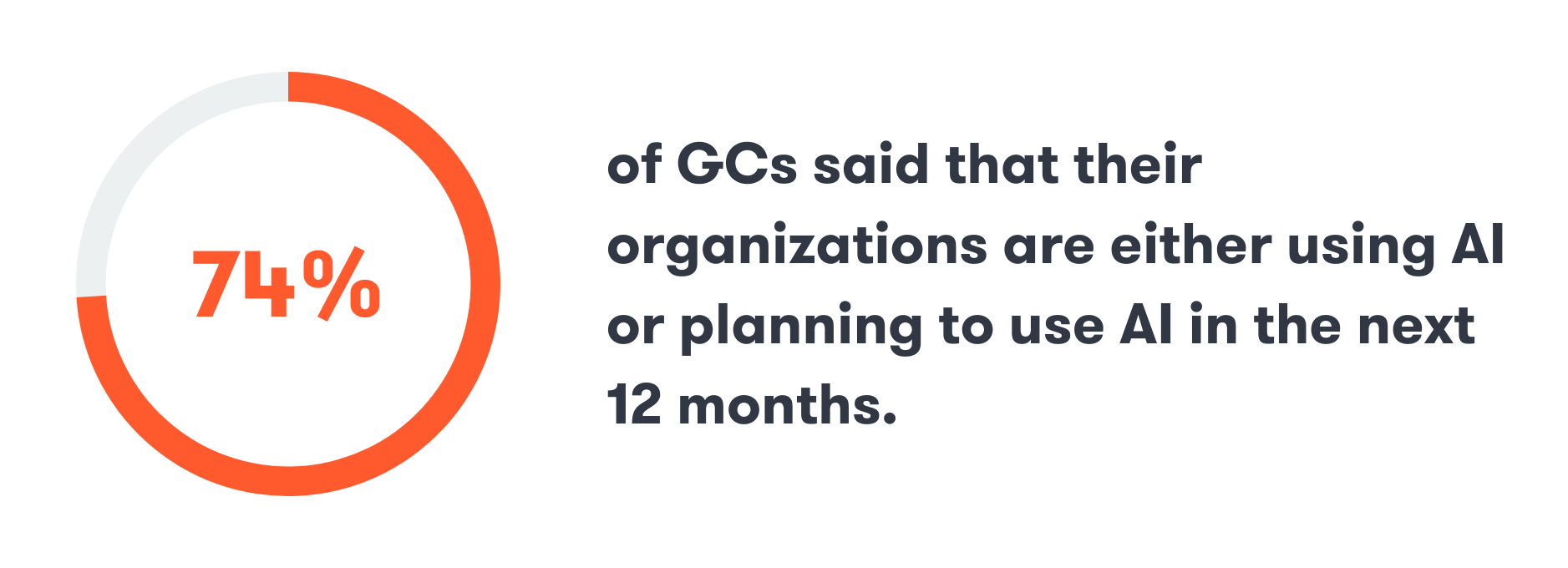
The webinar kicked off with a striking statistic from Axiom’s latest GC survey report: 74% of respondents said that their organizations are either using AI or planning to use AI within the next 12 months. Harpin also noted that AI governance had jumped from being the 9th priority in organizations in 2022 to the second highest priority in 2023 when compared to Axiom’s previous survey results. This rapid shift underscores the urgent need for companies to establish robust AI governance frameworks.
Wolf emphasized the complexity of the current AI landscape, stating, "AI is not new, but the AI act and everything that comes hand-in-hand with it, be it in the EU or be it in the US, that is. And it’s really complex." As organizations navigate this new terrain, legal professionals play a crucial role in guiding them toward effective AI policy drafting.
Leveraging Existing Privacy Frameworks
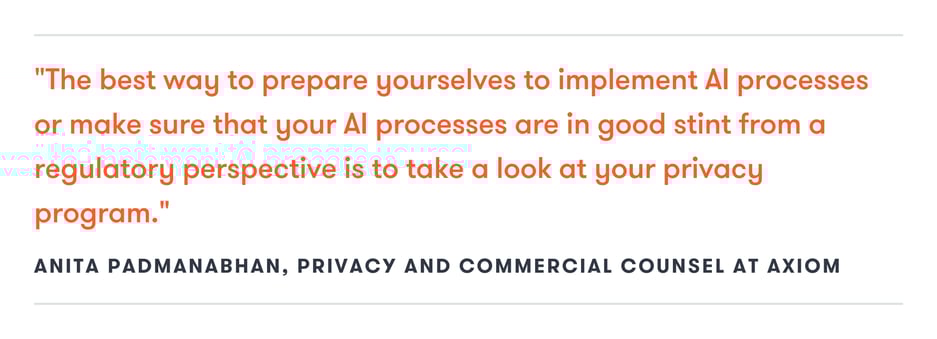
One of the key takeaways from the webinar was the importance of leveraging existing privacy frameworks and policies when drafting AI policies. Padmanabhan advised, "The best way to prepare yourselves to implement AI processes or make sure that your AI processes are in good stint from a regulatory perspective is to take a look at your privacy program."
To build a solid foundation for AI governance, the panelists suggest considering the following actionable steps:
- Assess the maturity and robustness of your current privacy program
- Identify relevant stakeholders from legal, privacy, information security, HR, procurement, and other departments to provide input
- Integrate AI considerations into existing data privacy policies and frameworks
Get Support from Axiom's Lawyers With AI Experience
- 200+ lawyers with specific AI experience
- Access top lawyers at up to 50% lower rates than top law firms
Engaging Stakeholders Across the Organization
Effective AI governance requires the active involvement of stakeholders across the organization. Wolf highlighted the importance of defining the AI organization a company wants to have and the goals it aims to achieve. He suggested considering the following questions:
- What structures do we have in place that we can leverage for AI governance?
- What are our specific goals related to AI adoption and innovation?
- What resources, including workforce and budget, do we need to achieve these goals?
To engage stakeholders effectively, the speakers posed the following tips:
- Establish regular touchpoints between legal, product development, and procurement teams.
- Assign legal professionals to interface with product teams and stay informed about AI-related developments.
- Foster open communication and collaboration to find solutions that balance innovation and risk mitigation.
Balancing Innovation and Risk Mitigation
Striking the right balance between fostering innovation and mitigating legal and ethical risks is a critical challenge in AI policy drafting. Wolf advised considering the following approaches to navigate this balance effectively:
- Implement human oversight and decision-making for high-impact AI processes.
- Establish clear guidelines and guardrails for AI usage within the organization.
- Regularly assess and monitor AI systems for potential risks and unintended consequences.
Adopting a Practical Approach
Finally, the panelists emphasized the importance of adopting a practical approach to AI policy drafting. Padmanabhan noted, "I think that a practical approach is needed. You can have a maturity level of your program that is quite high like the best standard. But what is your business?"
To adopt a practical approach, the panelists shared the following recommendations:
- Tailor AI policies to your organization's specific industry, data practices, and risk profile.
- Focus on achieving good practice rather than striving for perfection in the face of uncertainty.
- Leverage existing frameworks like NIST and OECD guidelines as starting points, rather than reinventing the wheel.
Conclusion
As organizations increasingly adopt AI and generative AI tools, the role of legal professionals in drafting effective AI policies has never been more critical. By leveraging existing privacy frameworks, engaging stakeholders across the organization, balancing innovation with risk mitigation, and adopting a practical approach, companies can navigate the complex AI landscape with greater confidence and success.
To learn more about the insights shared in this article, we invite you to watch the full "Everyone is Using AI - Now What?" webinar on-demand. If your organization needs legal talent with experience in AI policy drafting, Axiom has a pool of over 200 lawyers ready to support your AI-related legal needs. Contact Axiom today to learn more about how our knowledgeable legal professionals can help you tackle the challenges and opportunities of AI adoption.
💡 Explore the ways you can start leveraging Artificial Intelligence.
Posted by Kelsey Provow
Kelsey Provow is an award-winning writer and editor passionate about sharing unique and thought-provoking narratives. After obtaining her master's degree in professional writing, she has spent over a decade writing across multiple industries, including publishing, academia, and legal.
Related Content
Continuous Volatility Is the New Normal: Building Corporate Legal Departments for Constant Disruption and Uncertainty
Corporate legal teams must adapt to constant global disruption by building flexible, cost-efficient resourcing models for evolving risk and demand.
Same Problem, One Fix: How a Change Management Framework Can End AI Stall and Law Firm Habit Together
Law firms and AI adoption share the same root problem: change resistance. Learn how the Beckhard-Harris model helps legal teams drive transformation.
What the Quiet Revolution Taught Us
Axiom CRO Sara Morgan on 26 years of ALSP growth: why in-house legal leaders are 3x more satisfied with alternative providers—and what comes next.
The Law Firm Reflex Is Costing You Millions
Axiom CRO Sara Morgan: 61% of legal departments default to law firms when workload spikes, and it's costing them millions. Here's how to break the reflex.
AI Governance Framework: How Legal Teams Can Get It Right
AI governance framework guide for legal teams: risk-based AI policies, data governance, vendor safeguards & compliance best practices.
The Real Reason Legal Departments Can’t Change—And What to Do About It
New Axiom research reveals mindset—not budget—is the biggest barrier to legal transformation, and how GCs can close the knowing-doing gap.
Will AI Replace In-House Lawyers? What General Counsel Need to Know
Will AI replace lawyers? Discover how AI is transforming legal work. Learn why human judgment, business acumen, and communication matter more than ever.
What the WSJ $3,400 an Hour Story Really Means for Legal Teams
Premium firms may charge $3,400/hr, but budgets break from rising associate rates. Legal teams need elastic capacity plus AI to control spend.
Best in Class: Study Ranks Axiom #1 Across Key Performance Metrics
Axiom ranks #1 in 8 out of 9 key performance metrics for flexible legal talent providers, demonstrating unmatched expertise, coverage, and cost-effectiveness. Discover why GCs trust Axiom.
ESG Reporting: Full Guide, Standards, and Requirements
Learn what ESG reporting is, key frameworks like GRI and SASB, evolving regulations, and how to build a reporting program that delivers real business value.
Law.com: The CLOUD Act, Encryption and the US-UK Standoff in 2026
The US-UK encryption standoff has trapped tech companies between irreconcilable mandates—in-house counsel must navigate strategic risks when compliance with both jurisdictions becomes impossible.
AI Contract Management: What Legal Teams Need to Know
As legal teams face mounting pressure to do more with less, AI contract management solutions offer a compelling answer, transforming the contract process.
Why 80% of In-House Teams Are Rethinking Their Law Firm Relationships
New research reveals a legal market caught between legacy habits and transformation, with significant implications for how legal work gets done.
State Privacy Laws: 2026 Changes & Compliance
Navigate 2026 state privacy law changes across 15 states. Learn compliance requirements for Indiana, Kentucky, Rhode Island & key CCPA updates.
Why Axiom Outperforms LPO on Quality, Flexibility, and Business Impact
While LPO can solve some problems, it frequently creates new ones. This is where Axiom’s model offers a fundamentally different and better approach.
Finding Professional Confidence, Personal Balance: How Axiom Empowered a Commercial Attorney's Career Transformation
Discover how Axiom empowered commercial attorney Eileen to rebuild her career and confidence while balancing single parenthood after personal tragedy.
The AI Paradox: Why Your Legal Team's Productivity Gains Are Fueling a Retention Crisis
93% of legal professionals say AI boosts productivity, yet 76% fear job loss. New research reveals how AI anxiety is driving turnover. See the new data.
Essential Resources for In-House Legal Teams: 2025 Year in Review
Explore Axiom's top 2025 legal resources on AI adoption, talent retention, budget transformation, regulatory insights for in-house legal teams, and more.
Continuous Volatility Is the New Normal: Building Corporate Legal Departments for Constant Disruption and Uncertainty
Posted by David McVeigh- North America
- Must Read
- Expertise
- Legal Department Management
- Work and Career
- Perspectives
- State of the Legal Industry
- Legal Technology
- United Kingdom
- Australia
- Hong Kong
- Singapore
- Artificial Intelligence
- General Counsel
- Central Europe
- Legal Operations
- Solutions
- Regulatory & Compliance
- Spotlight
- Data Privacy & Cybersecurity
- Technology
- Commercial & Contract Law
- Corporate Law
- Global
- Tech+Talent
- Axiom in the News
- Large Projects
- Finance
- Law Firms
- Featured Talent Spotlight
- GC Report
- Healthcare
- Cost Savings
- Intellectual Property
- Videos
- Capital Markets
- Diversified Financial Services
- Labor & Employment
- Secondments
- Budgeting Report
- Commercial Transaction
- Energy
- Investment Banking
- Regulatory Response
- Banking
- Construction
- Consulting
- Consumer Packaged Goods
- Financial Services
- Healthcare & Life Sciences
- In-House Report
- Industrial
- Legal Support Professionals
- Manufacturing
- Materials
- Mergers and Acquisitions
- Pharmaceuticals
- Retail
- Transportation
- Aerospace & Defense
- Automotive
- Business Services
- Consumer Services
- DGC Report
- Education
- Food And Beverage
- Hospitality
- Insurance
- Litigation
- Private Equity
- Professional Services
- Public Sector
- Real Estate
- Specialized Advice
- Telecom
- Utilities
- News
- Recruitment Solutions
Get more of our resources for legal professionals like you.