


100% of AI-Using Legal Teams Are Raising Their AI Budgets. Only 17% Can Formally Measure Whether It Works.
The first wave of legal AI adoption was about access. The second wave is about accountability, and most legal departments are not ready for it.
Legal teams no longer need convincing that AI matters. In Axiom’s 2026 In-House Legal AI Report, every surveyed legal team already using AI expects its AI budget to grow in the next cycle. None plan to cut. The conviction is near-total, and it cuts across company size, industry, and AI maturity.
FIGURE 1
Every legal team plans to raise AI spending.
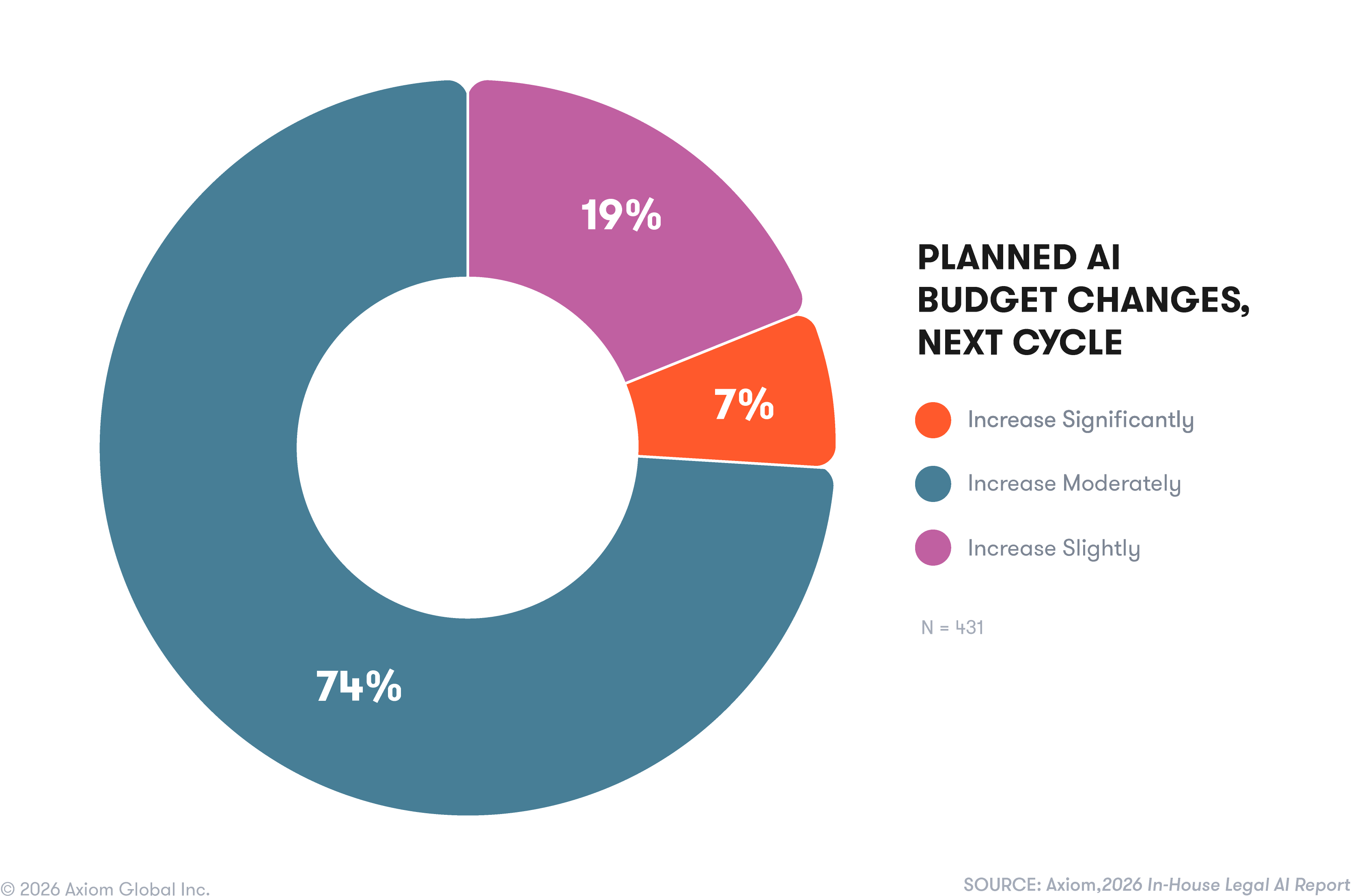
What has not kept pace is the ability to say whether the money is working. Only 17% of AI-using teams have established metrics and track AI ROI regularly. The other 83% do not. That gap—accelerating spend on one side, thin measurement on the other—is the defining tension of legal AI right now.
The 83% are Not Who You Think
It would be easy to read “83% can’t measure ROI” as a market full of teams flying blind. The data tells a more specific, and more interesting, story.
The teams without established metrics are overwhelmingly not non-measurers. They are informal measurers. Just over half of all AI-using teams (51%) say they do track ROI or productivity gains, but only inconsistently and without a formal framework. Another 29% say they are actively developing a measurement approach. Fewer than 3% say they have no plans to measure at all.
Indeed, the real divide is not between teams that measure and teams that don’t. It is between the small group that has built measurement into how they run AI and the large majority that is improvising it. This is essentially a measurement-maturity gap, not a measurement vacuum, and that distinction changes what closing it requires.
Confidence Without Proof
Here is where the mirage becomes literal. Even as 83% of teams lack established metrics, they are not hesitant about the returns. Asked how AI ROI compares to their initial expectations, 61% say it has met or exceeded them, including 8% who say it significantly exceeded them. Almost everyone reports a concrete productivity gain, most often in the 10% to 29% range.
Read those two findings together. The majority of legal teams are reporting specific, favorable returns on AI investments, despite acknowledging that those returns are not being formally measured. That is not necessarily wrong. Early returns can be real and visible before the instrumentation catches up. But it is fragile. ROI built on impression rather than measurement can only hold up until someone in finance asks how the number was derived.
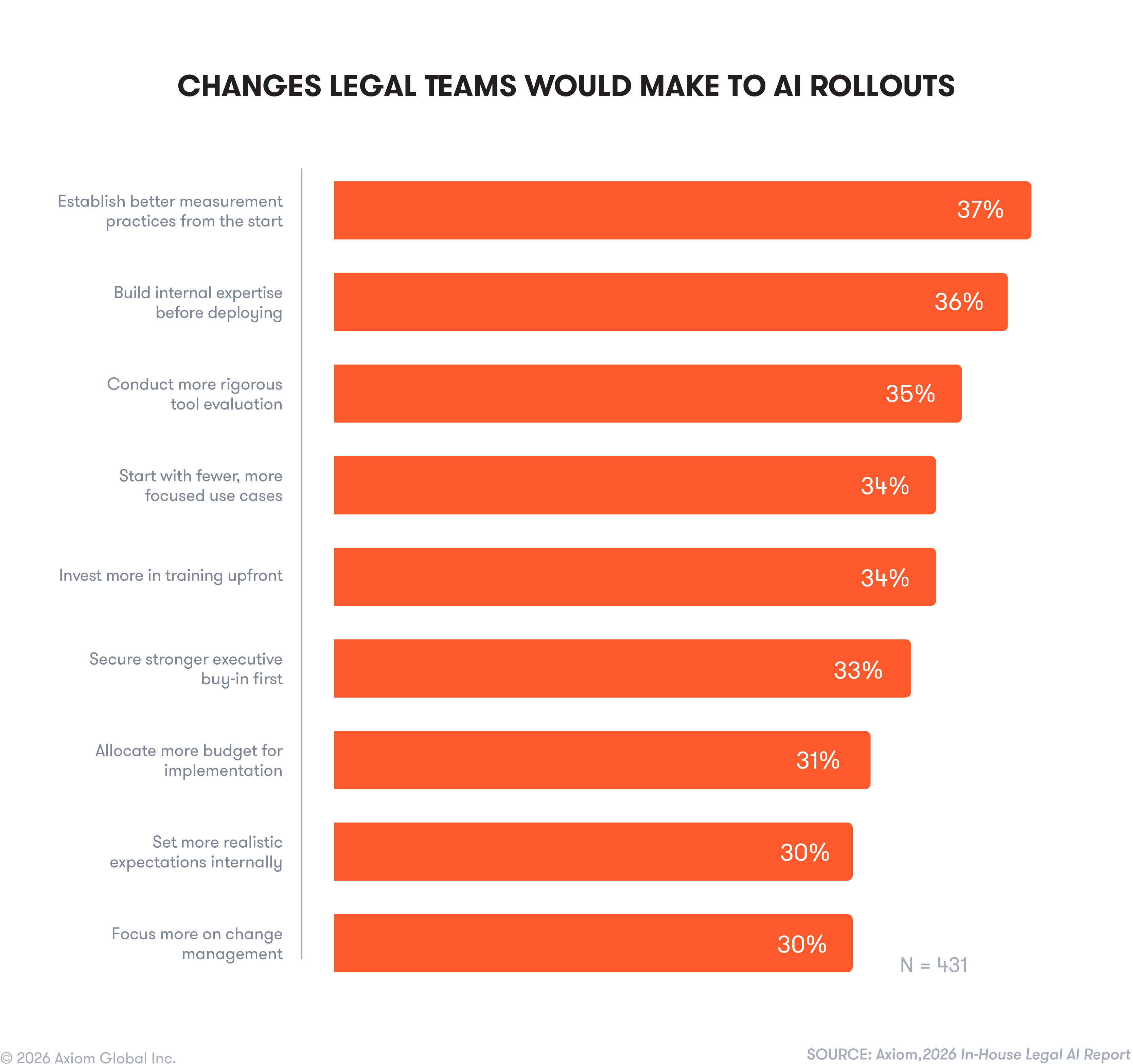
The teams themselves seem to sense it. Asked what they would do differently if they could restart their AI journey, the single most common answer was not different tools, more budget, or stronger executive support. It was establishing better measurement practices from the start, cited by 37% of respondents. “Difficulty measuring and demonstrating ROI” also lands among the most-cited barriers to getting more value from AI, named by 39%. The problem is not that teams don’t know that measurement matters, but that they have not operationalized it.
FIGURE 2
Establishing better measurement practices from the start is the priority.
What Gets Counted, and What that Reveals
When teams do track AI value, the metrics skew toward hard, defensible outcomes rather than enthusiasm. The most common measure is quality and error reduction (58%), followed by avoided outside-counsel spend (45%), internal labor cost reduction (43%), throughput (38%), time savings (36%), and cycle-time reduction (35%). Softer indicators sit at the bottom of the list: user adoption (23%) and user satisfaction (14%) are the least-tracked metrics of all.
That is encouraging on its face. Teams are reaching for outcomes a CFO would recognize. But knowing which metrics matter is not the same as having the discipline and infrastructure to capture them consistently. The instinct is right; the execution is informal.
Where the Value Actually Shows Up
The teams that do see clear returns tend to see them in the same places. Perceived ROI concentrates heavily in document-intensive work: legal research is named as the highest-ROI use case by 39% of teams, followed by document summarization (11%) and contract review (7%). Most other use cases trail well behind. The lesson the leaders have internalized is to prove value in a narrow, high-yield workflow before trying to scale everywhere at once.

The Training Mirage
The same pattern hides one layer beneath the ROI question. Ask a general counsel whether the department is investing in training, and the honest answer is yes. Teams report a full slate of programs: tool-specific certifications and ongoing skills development (both 51%), AI ethics and responsible-use training (47%), and prompt-engineering instruction (43%). Virtually none report having no formal training at all. On paper, the people side of AI looks covered.
The amount of training tells a different story. Most legal team members received just two to five hours of AI-specific training over the past year, and roughly nine in ten received ten hours or fewer. This is a remarkably thin investment in what may be the largest shift in how lawyers work in a generation. The shortfall shows downstream. Only about one in ten teams rate their users as advanced, while nearly six in ten sit at merely intermediate, and close to a third of team members rarely or never use the company-licensed tools at all. Counting training programs is easy, but the number of programs is not the same as proficiency, and proficiency is the thing that is not moving. Like ROI, training ends up measured by activity rather than outcome.
The Accountability Wave
For most of legal technology’s history, purchases were justified on the promise of future efficiency. AI may be the first wave where leadership expects proof, and where the teams that can produce it will pull away from the teams that cannot.
The organizations most likely to benefit from AI over the next several cycles are probably not the ones spending the most. They are the ones that can answer a deceptively simple question before everyone else can: What does success look like here, and how will we know when we have reached it?
The budgets are committed. The tools are in place. What separates the 17% from everyone else is the discipline to measure and, for many teams, the outside help to build that discipline faster than they could alone. In this report, when legal teams were asked who they would turn to for help getting AI right, they chose alternative legal services providers over law firms by more than two to one. The market is not just spending. It is asking for a way to prove the spending was worth it.
This is only a slice of what the data shows. The sneak peek edition of the 2026 Axiom In-House Legal AI Report, “Legal AI is Everywhere. Now Comes the Hard Part,” goes deeper still—on who is getting legal AI right, where measurable value concentrates, and who in-house teams trust to help them get there. Grab the sneak peek now to get the early findings, and to be first in line for the full report when it publishes later this month.