


The Axiom 2027 In-House Legal Budget Report found that legal departments head into 2027 facing a crowded list of uncertainties. Regulatory and compliance changes, AI policy and governance, and geopolitical instability each worry roughly half of legal leaders. The report didn’t show how teams are actually budgeting for those shocks.
We asked all 510 respondents to name the primary strategy they’re using to budget for three kinds of uncertainty in 2027: uncertainty in the business environment, in the political environment, and in regulation and policy. Not one respondent said they had no strategy. The tools they reach for are remarkably consistent, but how heavily they lean on each one varies, especially by region.
Three ways to absorb a shock
The answers fall into three broad approaches. Some teams set aside cash: they increase budget buffer percentages or create separate contingency line items. Some build in capacity: they increase budget for flexible talent so they can add expertise when it’s needed. And some change the process: they move to rolling or continuous budgeting models, or revisit the budget more often.
A fourth option, building scenario-based budgets with best- and worst-case versions, was rare. Only 7% to 8% of respondents chose it as their primary approach for any uncertainty.

Different shocks, the same three tools
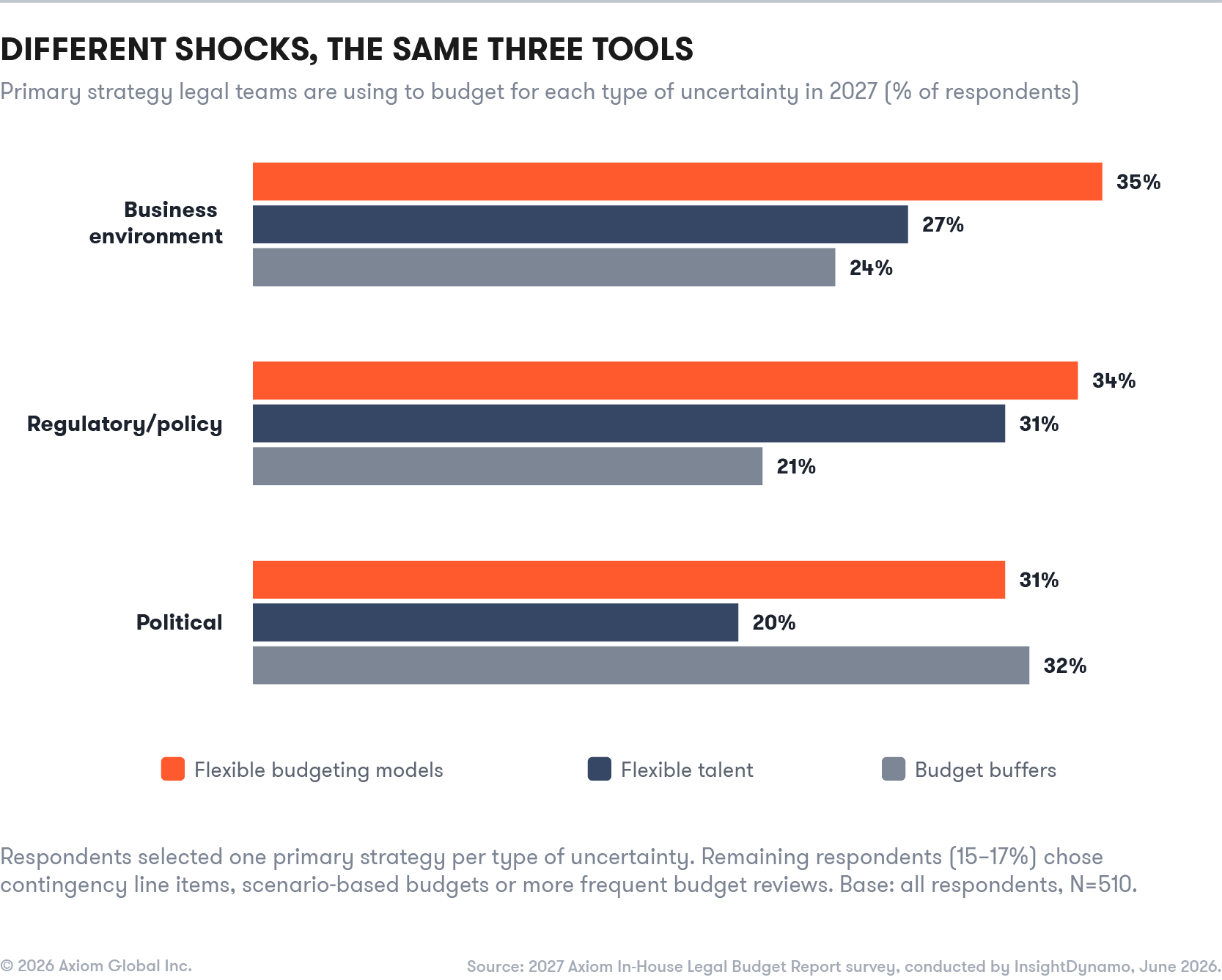
Look at each type of uncertainty separately, and the same three strategies come out on top every time.
For uncertainty in the business environment, moving to more flexible budgeting models is the most common primary strategy at 35%. Increasing budget for flexible legal talent follows at 27%, and increasing budget buffers at 24%.
For regulatory and policy uncertainty, the order holds. Flexible budgeting models lead at 34%, followed by flexible talent at 31% and buffers at 21%.
For political uncertainty, the order shifts but the tools don’t. Budget buffers and flexible budgeting models are essentially tied for the top spot, at 32% and 31%, with flexible talent third at 20%.
Across all three, between 83% and 85% of respondents chose one of these three strategies as their primary approach.
What the three have in common is flexibility. A buffer gives a team money it hasn’t yet committed. A rolling budget gives it permission to change course mid-year. Flexible legal talent gives it expertise it can add without a permanent hire. Each is a way of keeping options open rather than predicting the shock in advance.
The ordering does move in one notable way. Flexible talent climbs from 20% for political uncertainty to 31% for regulatory uncertainty. That fits the nature of the work: a regulatory change tends to produce specific tasks that call for specific expertise, while a political shock is harder to size or time.
The UK holds cash for political risk
UK legal departments are the most likely to answer political uncertainty with money in reserve. 47% are primarily increasing budget buffers for political risk, compared with 33% in North America and 17% in APAC.
UK teams are also the most likely to build scenario-based budgets for uncertainty in the business environment, at 14% versus 6% in North America. And they are among the readiest to use flexible capacity for other kinds of uncertainty: when hiring needs are hard to predict, 23% of UK respondents turn to flexible talent instead of permanent hires, compared with 14% in North America.
North America relies on budget mechanics
North American teams are more likely than their peers to manage uncertainty through how the budget itself is built. For regulatory uncertainty, 39% are primarily moving to more flexible budgeting models, compared with 30% in the UK and 26% in APAC. For uncertainty in the business environment, 28% are primarily increasing buffers, versus 16% in APAC.
What North American teams use less is flexible capacity. Only 25% primarily answer regulatory uncertainty with flexible talent, the lowest of any region.
Strengthen your response to regulatory uncertainty with flexible, on-demand legal expertise.
APAC builds capacity for regulatory change
APAC teams take the opposite approach. For regulatory uncertainty, 41% are primarily increasing budget for flexible talent, the highest of any region. And APAC teams are the least likely to hold cash against political risk: just 17% rely primarily on buffers, less than half the UK rate.
APAC teams were also the most likely to build scenario-based budgets for political uncertainty, at 13%. That figure comes almost entirely from Hong Kong, where 36% of a small group of 25 respondents chose scenario budgets, compared with 9% in Australia and 3% in Singapore.
The planning tool almost no one uses
Across regions, the least common primary approach is the most deliberate one. Scenario-based budgeting, which forces a team to define in advance what it would do if a shock arrived, was the primary choice of fewer than one in ten respondents for every type of uncertainty.
That may be a missed opportunity. A buffer sets money aside; flexible talent sets capacity aside; a rolling budget allows room to adjust. A scenario-based budget is the one approach that decides in advance how to combine them. A legal team that has mapped out how it would spend a buffer, which work it would hand to flexible talent, and when it would reopen the budget is better placed than one holding any single tool.
For legal leaders heading into budget season, the regional data offers a practical check: is your team’s default approach the right fit for the kind of shock you’re most exposed to? The UK’s cash, North America’s mechanics, and APAC’s capacity each answer a different risk well within the same three-part toolkit. The strongest plan likely draws on all three.
Methodology note: Data are drawn from the 2027 Axiom In-House Legal Budget Report survey, conducted online by InsightDynamo on behalf of Axiom, June 9–15, 2026, among 510 in-house legal and finance leaders at companies with at least $250 million in annual revenue across six countries. Respondents selected one primary strategy for each type of uncertainty. Regional groupings follow the main report: North America (United States and Canada, n=281), United Kingdom (n=100), and APAC (Australia, Hong Kong, and Singapore, n=129). Regional breakouts and strategy data by type of uncertainty were not included in the published report.