



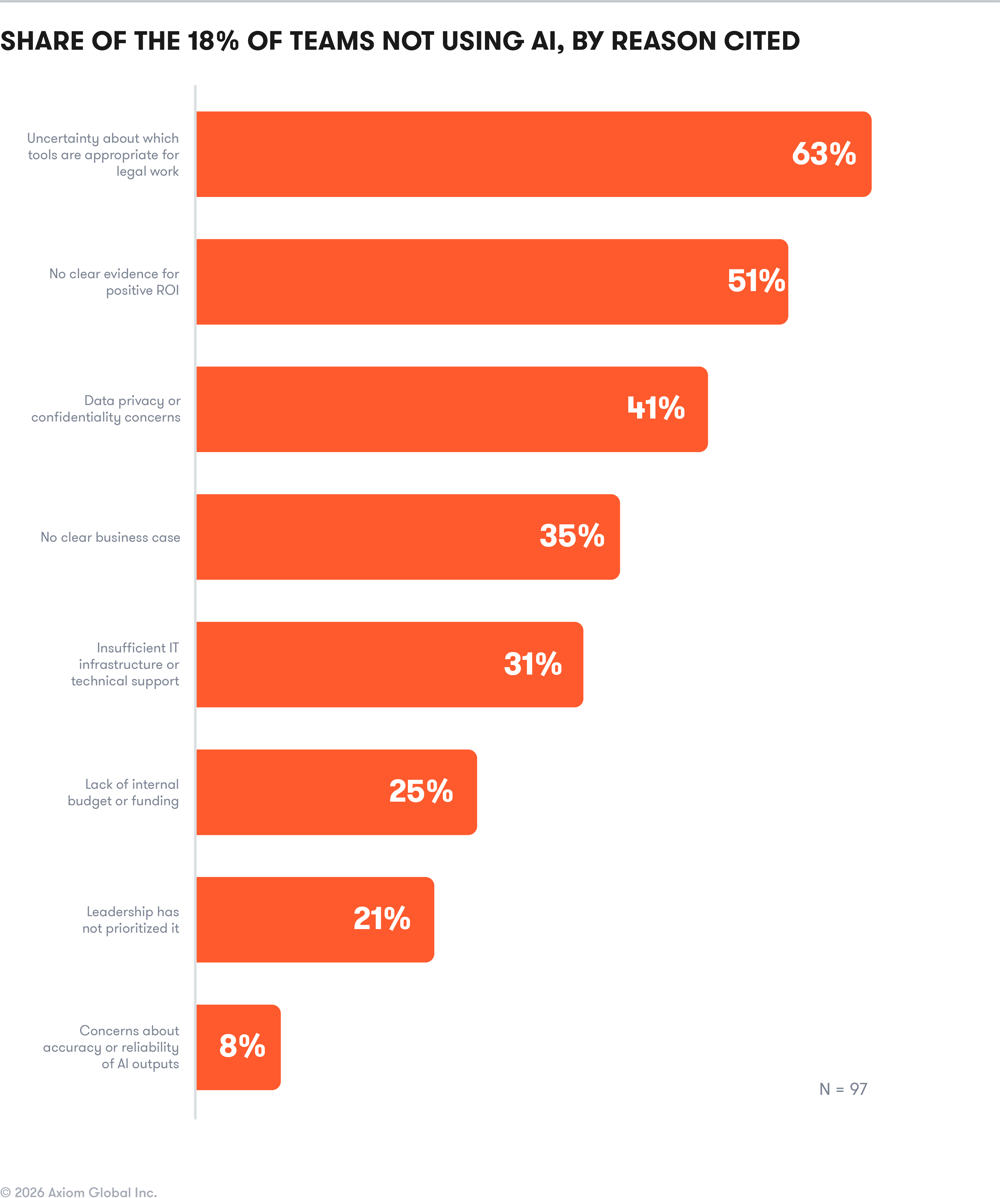
Eighteen percent of in-house legal teams surveyed for Axiom’s 2026 In-House Legal AI Report haven’t started using AI in any form. They’re not piloting, not exploring, nothing. Asked why, they point to confusion, not cost: 63% cite uncertainty about which tools are appropriate for legal work, 51% say there’s no clear evidence of positive ROI, and only 25% point to budget. Leadership apathy barely registers, at 22%.
That finding is already in the report. It answers a look-backward question: What’s kept these teams on the sidelines so far?
A companion question in the same survey asks something different, and it points somewhere the published findings don’t: What would actually need to change for these teams to begin exploring AI at all. The answers reorder the entire list.
FIGURE 1
Eighteen percent of in-house legal teams haven't started using AI in any form. Why?
The Forward-Looking Question Changes the Answer
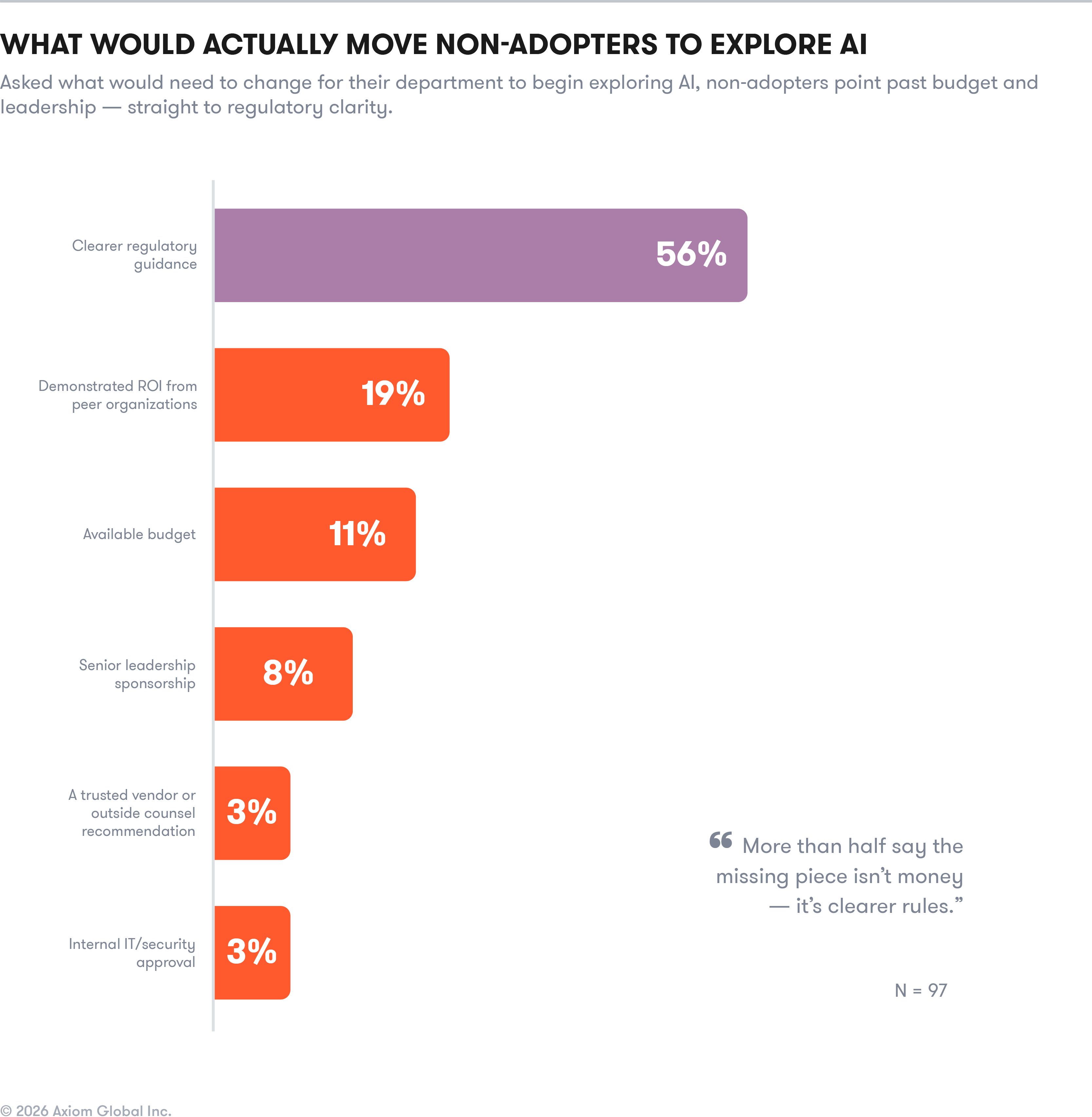
Clearer regulatory guidance was cited by 56% of non-adopters, more than double the next most-cited factor. “Demonstrated ROI from peer organizations” came in at 19%. “Available budget” — the resource question every AI conversation seems to default to — was named by just 11%. “Senior leadership sponsorship” trailed even further behind, at 8%.
Read the two questions together and a pattern emerges. The barriers non-adopters name when asked to look backward are about the tools themselves, not knowing what to buy, not trusting the ROI case. But when asked to look forward, what they’re actually waiting for isn’t a better vendor pitch or a bigger budget line. It’s the law catching up with the technology. Money and executive buy-in, the two things most AI adoption playbooks treat as the real obstacles, turn out to be almost beside the point for this group.
A Market Stuck in the Middle
It also explains why this cohort looks stuck rather than simply behind. Asked how likely their department is to begin actively exploring AI tools in the next 12 months, 63% landed on “neither likely nor unlikely” — the noncommittal middle. Only 14% said somewhat likely; none said extremely likely. This isn’t a group racing to catch up once the fog clears. It’s a group that has genuinely paused, waiting for a signal that hasn’t arrived yet.
For legal leaders already using AI, the instinct might be to read this as risk-aversion dressed up as prudence. But the emphasis on regulatory clarity over ROI or budget is arguably the more defensible position, not the less defensible one. Indeed, legal departments carry professional responsibility and compliance obligations that other functions don’t. Waiting for the rules of the road before committing budget and headcount to a new way of working isn’t the same as waiting for permission to feel comfortable. It’s a rational response to ambiguity about where the lines are.
Turn regulatory uncertainty into a workable approach to AI adoption with legal talent experienced in technology and compliance.
FIGURE 2
Most are waiting on the law to catch up with the technology.
The Pitch Nobody’s Making
What it means for everyone else in the market — vendors, ALSPs, law firms, industry associations — is that the pitch aimed at this 18% is currently misaligned. Case studies promising ROI and offers to ease budget pressure are answering a question this group isn’t really asking. The teams still on the sidelines aren’t holding out for a better business case. They’re holding out for a clearer legal one. And until regulators, bar associations, or authoritative industry guidance narrow that ambiguity, no amount of vendor persuasion is likely to move them off “neither likely nor unlikely.”
That creates an unusual opening. Whichever source manages to translate emerging AI regulation into something a general counsel can act on won’t just be offering information. They’ll be handing the most reluctant 18% of the market the one thing they’ve said would actually get them off the fence.
For legal teams that need to act before that clarity fully arrives, experienced artificial intelligence lawyers can help translate emerging requirements into practical policies, risk assessments, and governance processes.