



Legal department leaders have always had to balance unpredictable workstreams in a fast-paced business environment, watch out for the development and job satisfaction of their teams, and demonstrate return on investment with legal spend – even without an economic downturn.
Alternative resourcing models are a key tool for GCs to address those challenges. For those who have not explored these models, in this two-part series, Using Flexible Talent to Build a Resilient Legal Organization, you’ll learn about a different way to partner with ALSPs like Axiom, which provides the right combination of consistency and flexibility for addressing variable workloads and shifting business priorities. Not only will you be able to better manage costs, you’ll enable your teams to focus where they’re needed most to advance the business, while building an operating model that is resilient and prepared for future disruption.
 The good news is that this isn’t experimental or bleeding-edge – it’s a tested and successful engagement model that has been pioneered by forward-thinking legal leaders like Sam Miller, a legal advisor and executive consultant who held multiple roles in her 27 years at Intel, including DGC of Business Legal, Corporate Secretary, and GC of Intel Capital, the company’s investment arm. Here’s her story.
What led you to start down the road of using flex counsel in an intentional way? It was not a very common practice at the time beyond the occasional parental leave, so this required some vision.
It really started with my experience in managing workload while I was GC of Intel Capital. My first year in the role, the number of investments we were doing went from four to six a year to 30-plus, and it skyrocketed from there. That first year I didn’t have time to hire and train new in-house lawyers. I had to rely on my outside counsel. Even then, I started looking for ways to streamline the time I needed to spend with them on any one matter. The primary way I did that was by curating a small group of partners and associates within the firm that were familiar with our people, process, and legal positions. I made the lawyers part of the team – including them in group events, holding training sessions on technologies for the associates, etc. By doing that I was able to create demand for working on my matters by a team that could jump right in when I needed them. It was a model somewhat analogous to today’s flex counsel.
Did you continue that same support model when you moved to the business legal group?
No – when I first moved to the business legal team, using outside resources was not really part of our support structure. We did the usual consulting with law firms and engaging them for big acquisitions, but the work was primarily handled by the internal team. My ICap model did give me the experience of how powerful it can be to have outside lawyers deeply embedded with my own team, which informed my thinking on resourcing options when the business legal team later had its own workload management challenge.
 What changed for you in the business legal team that led you to re-explore your options, and how did you come to use flex counsel?
My challenge was the same as today’s norm for legal department leaders – balancing sustainable workload levels for the internal team with the ever-increasing amount of legal work we wanted to do for the company. I had done everything I could with the usual options – internal hires, traditional law firms, and sole practitioners. I was headcount-limited, so that meant more internal hires were not an option. Turning to traditional outside counsel to fully solve our needs was challenging for a few reasons. First, in a traditional law firm, lawyers have multiple clients, which makes it difficult for them to commit a substantial amount of their time on a longer-term basis. The same is often true for sole practitioners. Second, we needed senior people who could work independently, which was not necessarily consistent with the portfolio of work that needed to be covered and at a higher cost structure than my budget could afford, so the economics didn’t work. Finally, often those who were available did not have the skill set I needed. I knew I had to find a broader solution, and began looking more closely at the flex counsel market to see if I could find a way to build on what I learned during my ICap time.
At that time, flex firms were still relatively new. Many were focused on providing more cost-effective models for certain legal workloads – like providing a team for a document production, or an acquisition diligence project, or outsourcing routine legal work like NDAs. I spoke to a couple of the flex firms and explained what I was looking to create. I walked away from those first discussions still feeling positive about the flex firm approach, but not seeing it as a solution for what I needed. They were focused on low-complexity/high-volume work, and just didn’t have the lawyers with the experience level or legal skill areas I needed. But Axiom was open to my idea. We collaborated on the list of substantive and soft skills, and I gave them feedback on lawyers that were joining the company and their fit for my group. Eventually they identified a lawyer with the skills I needed, and it took off from there.
 What were you hoping to get from your flex counsel?
Well, to begin with, access to a set amount of a flex lawyer’s time – 100% if that’s what I needed – plus significant flexibility to structure the scope and length of the engagement. Where lawyers in traditional law firms, even when at a company as a secondee, ultimately need to work with multiple clients in order to keep their firm career on track, many flex counsel don’t have those same considerations.
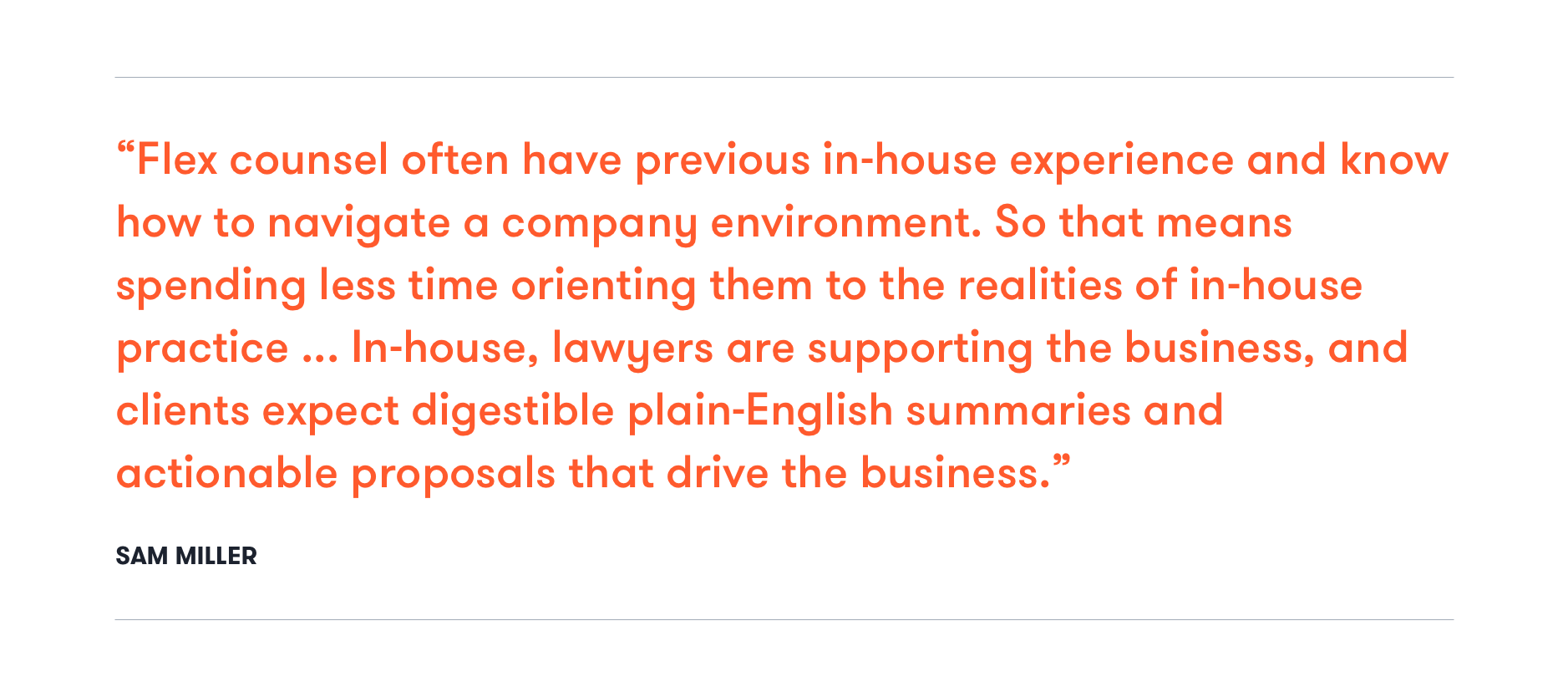
I was also looking for an accelerated ramp time. Flex counsel often have previous in-house experience, and know-how to navigate a company environment. So that means spending less time orienting them to the realities of in-house practice and how it differs from being in a firm where the lawyers and the practice of law are the business. In-house, lawyers are supporting the business, and clients expect digestible plain-English summaries and actionable proposals that drive the business. That requires not just a solid understanding of the company and its priorities, but an ability to build trust and rapport with your business partners, as well as a capacity for quickly absorbing and synthesizing large amounts of information.
Finally, I was looking to maximize my ability to adjust the team quickly as our needs changed. While flex counsel can work like an internal team member, they have the flexibility factor you get with outside counsel, so I could control when to phase support in and out.
What are some of the areas where you see the use of flex counsel as being particularly valuable?
Some of the situations where I used flex counsel on the transactional side include:
- When workload spiked beyond what we could appropriately manage internally, but I was headcount-constrained and, or I wasn’t sure if the work level was going to stay high or come back down;
- When a team member had the opportunity to work on a project that would take a significant amount of their time, and bringing in a flex person to cover the day-to-day work let the team member focus on the special project;
- When increasing a specific type of expertise beyond what we had internally;
- When needing resources to get something done by a certain time, like creating form agreements for a particular type of deal, that an internal team member could normally do, but just didn’t have the bandwidth to get it done as quickly as we wanted.
How did you think about the cost of flex counsel compared to the cost of your law firms?
Before jumping to a cost comparison, it’s important to keep in mind what you get with each of them. Flex firms and law firms are different types of resources to be used for different situations – there are sweet spots for each.
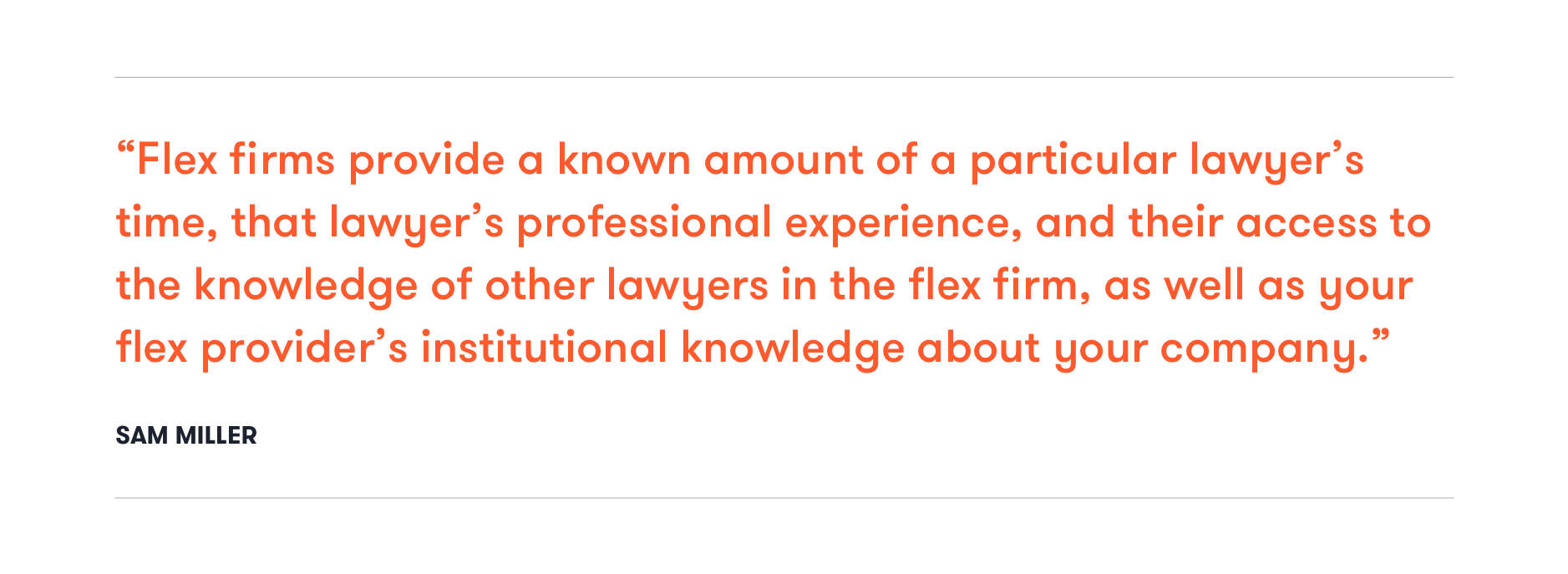
Flex firms provide a known amount of a particular lawyer’s time, that lawyer’s professional experience, and their access to the knowledge of other lawyers in the flex firm, as well as your flex provider’s institutional knowledge about your company. Traditional law firms provide a lawyer and that lawyer’s experience, their knowledge of your company, and their access to their broader scope of firm lawyers (from first-years to senior partners), plus the infrastructure support of paralegals and the administrative team.
The first critical question is to decide what scope of support you need for a particular piece of work or project. If you are staffing a large litigation matter or need a deep dive into a novel legal issue, then you’d be getting full use of what a traditional law firm provides. In contrast, if it’s the work product of a sole practitioner that you need or the kind of work you would handle in-house if you had the available resources, then the flex counsel structure makes more sense.
 Since so much of the work that you found to be ideal for flex counsel is aligned with in-house practice, why shouldn’t GCs just hire more permanent staff?
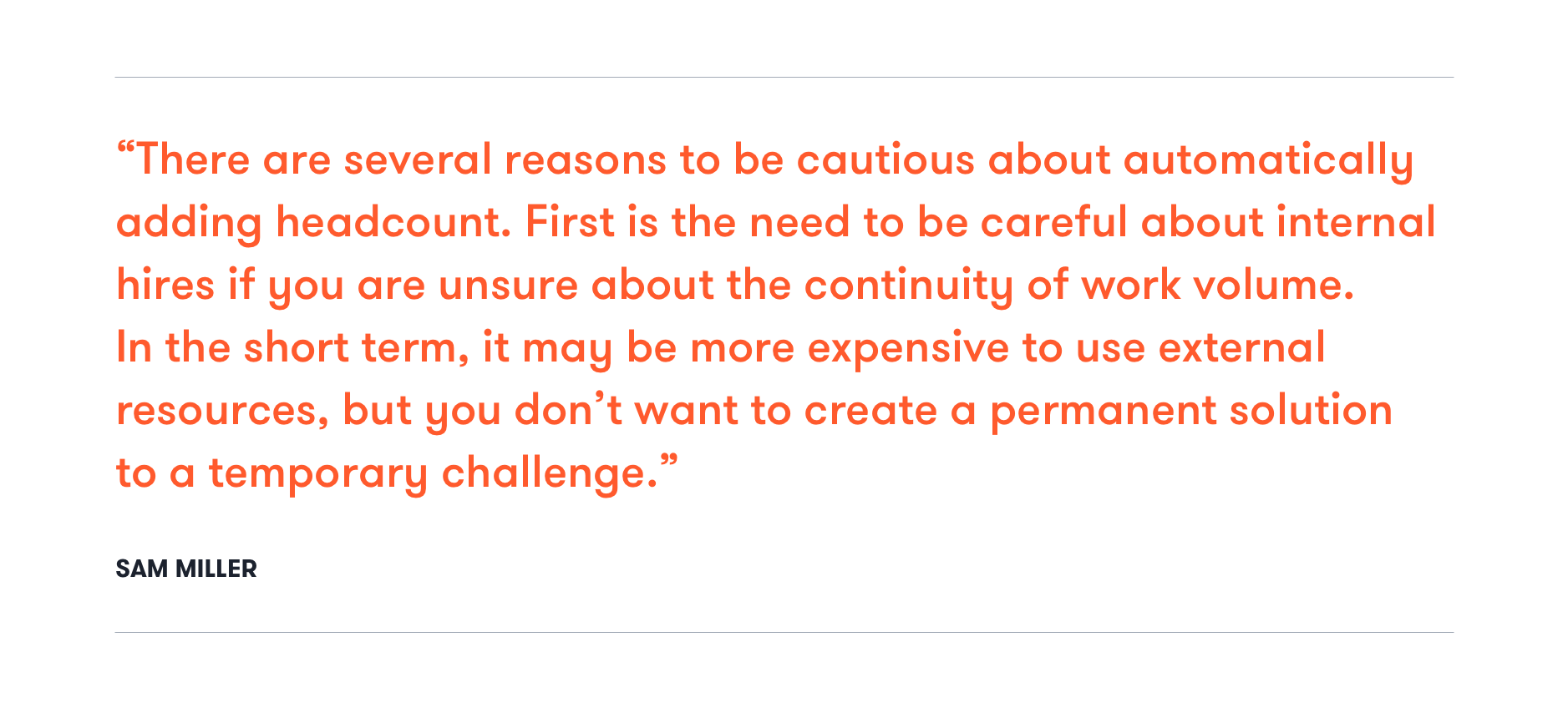
There are several reasons to be cautious about automatically adding headcount. First is the need to be careful about internal hires if you are unsure about the continuity of work volume. In the short term, it may be more expensive to use external resources, but you don’t want to create a permanent solution to a temporary challenge. For example, if the company is standing up a new business line, it can be a good opportunity to work with flexible talent. You may need additional people to set it up – working on privacy, compliance, commercial structure, sample agreements, etc. – but if the post-setup workload is going to be lower, bringing in permanent headcount can be risky. Even if ultimately hiring internally, starting with flex lawyers gives you more time to evaluate what skill set and level of seniority you need.
Second, the "cost" of hiring a full-time employee is greater than your fully-loaded headcount cost. You also need to factor in the time and resources needed to manage and develop your internal lawyers and the impact of creating more competition for promotions. While you can expect to pay a premium for flex counsel, the difference between the true cost of a permanent hire and flex counsel is often less than imagined.
Finally, you also need to consider the time it takes to bring on a permanent employee – if finding a new hire with the right skill set is even feasible. It can take months to hire and more time to really ramp into a role and be effective. Even if a permanent employee is the longer-term goal, flex counsel might be the right interim solution.
What advice do you have for legal leaders who may not have made the jump to working with flex counsel yet, or have only used it in a limited capacity?
If it’s been a while since you looked at the flex counsel talent pool, look again. It is far more mature than it was ten years ago, with increasing numbers of talented, experienced lawyers choosing to work in a flexible capacity. In fact, I see that trend continuing and even expanding.
Even if you aren’t looking to bring on flex counsel now, consider developing a relationship with a flexible talent provider like Axiom, and use them as a resource. They have become much savvier about the need to have relationship managers whose job it is to understand your business and your in-house legal department structure, and who can help you think through ways to use flex lawyers effectively.
Finally – just start. Flex firms are a powerful agility option for legal leaders striving to meet their company’s ever-changing needs.
For more insight from Sam Miller, including how to think strategically about flexible talent, download our free guide. To work with a trusted flexible talent provider, get in touch with us at Axiom.
About Sam Miller: Sam Miller is a legal advisor, executive consultant, and former DGC at Intel with nearly three decades of experience working at the intersection of law, business, and technology. At Intel she held a breadth of roles, including VP and Corporate Secretary, VP and DGC of Global Business Legal, and General Counsel of Intel Capital (Intel’s investment arm). Sam works with a broad range of companies and nonprofit organizations, and is a board member at the Law Foundation of Silicon Valley, the Minority Corporate Counsel Association, and the Oshman Family JCC.