



It’s no surprise to any in-house legal professional that technology- more specifically the application of artificial intelligence (AI)- has taken every industry by storm. For the past five years, large language models like ChatGPT and Copy.ai have offered companies opportunities for efficiency improvements across every department, but with those improvements comes the introduction of risk opportunities.
So how does the savvy general counsel (GC) address -or better yet, prevent- those risks? The obvious answer is to take advantage of their team’s resources.
In our recent survey View from the Top: GCs’ 2024 Outlook on Legal Budgets, Talent, and Innovation though, 300 US GCs shared experiencing a lack of resources across the board- the necessary budget, staffing, technology, expertise, and team structure- to accomplish their required tasks. With shrinking budgets and increasing workloads, most cannot afford such resource limitations, especially as the integration of AI becomes a more commonly accepted and encouraged strategy by executive leadership.
So naturally, the surveyed GCs reported to Wakefield Research that the top three practice areas most likely to be in demand within their organizations in the next 1-2 years are 1) technology and product development 2) data privacy and cyber security and 3) new or emerging areas, such as artificial intelligence.
.png?width=763&height=276&name=GC%20Survey%20Report%20Blog%20Post%202%20Stats%20(3).png)
Unfortunately, the stark reality facing U.S. legal leaders is that their current departments are woefully unprepared to meet these growing demands, as 65% reported a lack of technology and product development lawyers in-house, 47% said they have no data privacy and cyber security lawyers on staff, and 70% don’t have resources in-house for new or emerging practice areas like AI.
With the approval of the EU’s General Data Protection Regulation and the California Consumer Privacy Act, Axiom’s own GC Ashlin Quirk was not surprised when she read this year’s report: “The legal industry is evolving faster and in a more complex way than ever before, and the arrival of new technologies like artificial intelligence and the accompanying regulations mean in-house legal leaders must be quick to adapt.”
But if the workload is only increasing while the resources are only depleting, how can GCs adapt quickly and effectively? What are their options?
Option 1: The Traditional Law Firm
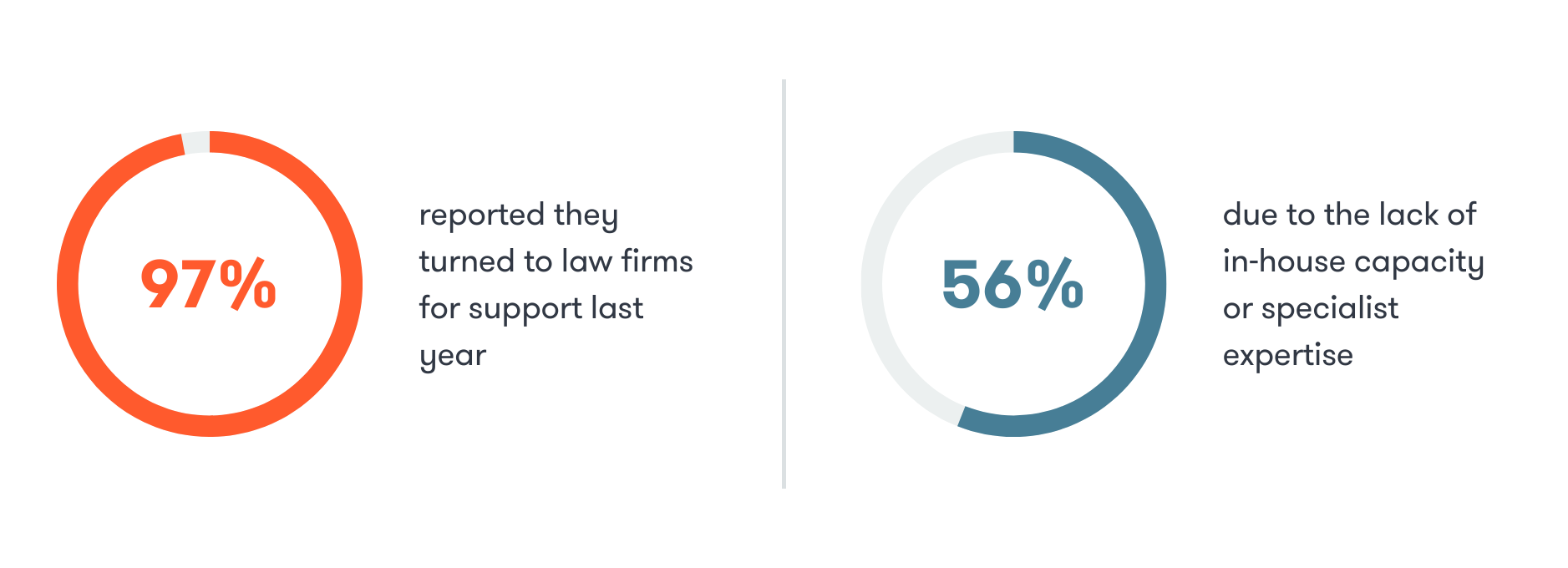
To compensate for the lack of in-house expertise, most GCs outsource matters to law firms. In fact, 97% of GCs reported they turned to law firms for support last year, with 56% doing so due to the lack of in-house capacity or specialist expertise. Almost a third of all survey respondents said three of the top four practice areas they’d most likely send to a firm for support would be: 1) data privacy and security (31%), 2) new or emerging practice areas, such as AI (29%) , and 3) technology and product development (28%).
Of those who did hire a firm, all (100%) found reasons to regret the alliance, with 89% reporting law firms were not a completely effective solution to their resourcing challenges, due to lengthy administrative management or onboarding process, lack of practical advice versus conceptual advice, lack of commercial/business acumen, and lack of institutional knowledge.
.png?width=1877&height=680&name=GC%20Survey%20Report%20Blog%20Post%202%20Stats%20(1).png)
And with many of the top firms increasing rates as high as 8%, GCs must ask themselves: is this option the most efficient resource?
Option 2: Hiring Full-time Staff
If time and staffing bandwidth allowed, all GCs (100%) said at least some of the work sent to law firms last year could have been done in-house instead of sent to a law firm, so it makes sense that most GCs would turn to hiring full-time staff to round out their in-house team. But unfortunately, 100% also reported difficulty in their department’s ability to hire the right attorneys to address their needs, due to budget cuts, turnover, and hiring freezes.
.png?width=1877&height=680&name=GC%20Survey%20Report%20Blog%20Post%202%20Stats%20(2).png)
In a recent interview with Legal Dive, Quirk explained that hiring individuals with data privacy and cybersecurity experience can be expensive: “Everybody’s going to need support figuring out how that impacts their business, their operations and any changes they need to make. But does everybody need someone to stay on full time and do that once you’ve got that compliance program in place? Probably not.”
Quirk believes it’s important to review what the team needs. While it may not be a full-time privacy resource, it’s possible that the team is missing someone to assist with a certain area of the business instead, like a certain product or a privacy-by-design review.
Now is the time for GCs to look outside the traditional binary resourcing model of staffing out (hiring law firms) or staffing up (hiring full-time staff).
Option 3: Alternative Legal Service Providers
“While the results may appear bleak,” Quirk commented, “there are many new and modern options to address departmental resourcing challenges.” Most (85%) of GCs said they’d be likely to outsource some of their legal matters to a flexible alternative legal talent provider rather than a traditional law firm- if they could do so at lower cost while maintaining a high level of quality and oversight of the legal team.
“There’s no more need to ‘do more with less,’” Quirk shared, “as providers like Axiom are equipped to quickly offer tailored solutions to innovative GCs.” With a bench of over 14,000 legal professionals with a deep understanding of practice areas, GCs can fill the knowledge gaps on their own teams with temporary or long-term solutions at a fraction of the cost of law firms or full-time staffing expenses.
Conclusion: Applying the Right Resourcing Matrix
While tough budget times are out there, in-house legal teams have been presented with the chance to innovate through the technology growth the industry is witnessing today. Shrewd GCs will have to adapt quickly to the growing demand for technology and product development, data privacy and cyber security, and new or emerging areas, such as AI. Quirk is excited to see new approaches in how legal departments utilize technology and outside legal talent, allowing teams to better serve internal stakeholders. But the right resourcing matrix is vital to the teams' success.