



The latest research from Axiom shows how lawyers are using AI
We know it can be scary – the idea that your job (and your hard-earned expertise) may be quickly replaced by technology. Equally as scary? The thought that the rapid adoption of a relatively new technology may exponentially increase the amount of risk introduced to your broader organization, making your hard job as a lawyer that much harder.
In fact, the very concept of a novel technology may be scary in and of itself – especially if you’ve found yourself behind the early adoption learning curve.
We’re here to help make it less scary, or at least more digestible.
We’ve asked 300+ in-house lawyers about their use of AI, their concerns about and ambitions for the technology, and AI’s implications on both their business and the legal industry at large. From that feedback, we’ve compiled the eight answers you really need to know. And, to help make the subject less intimidating, we’ve started with the most basic questions (ones you may have been too embarrassed to ask):
QUESTION 1:
What is ChatGPT?
ChatGPT is a natural language processing tool driven by AI technology. In layman’s terms, it allows you to have human-like conversations (and much more!) with a chatbot. The language model can answer questions and assist you with tasks such as composing briefs and emails.
QUESTION 2:
What is the difference between ChatGPT and a Large Language Model?
The architecture of a Large Language Model (LLM) is that you feed it a huge amount of data and it feeds you “language.” ChatGPT is an LLM that uses AI. OpenAI essentially created LLMs including ChatGPT. Now, there are many different LLMs (like Google’s Bard), and there will certainly be more in the future from other major technology players (Meta, for one).
QUESTION 3:
Are my legal peers using ChatGPT/LLM?
If you’re asking if you’re behind the curve, the answer may be yes.
The legal industry has been identified as one of the primary targets for AI disruption. A recent Goldman Sachs report forecasted that generative AI tools like ChatGPT will accelerate legal industry automation so much so that 44% of all current manual legal tasks may soon be automated.
And our stats validate that forecast – or at least legal’s early embrace of AI:
- Most in-house lawyers are familiar with AI and LLMs: 54% of in-house counsel are very or extremely familiar with AI and LLMs. A whopping 92% are at least somewhat familiar.
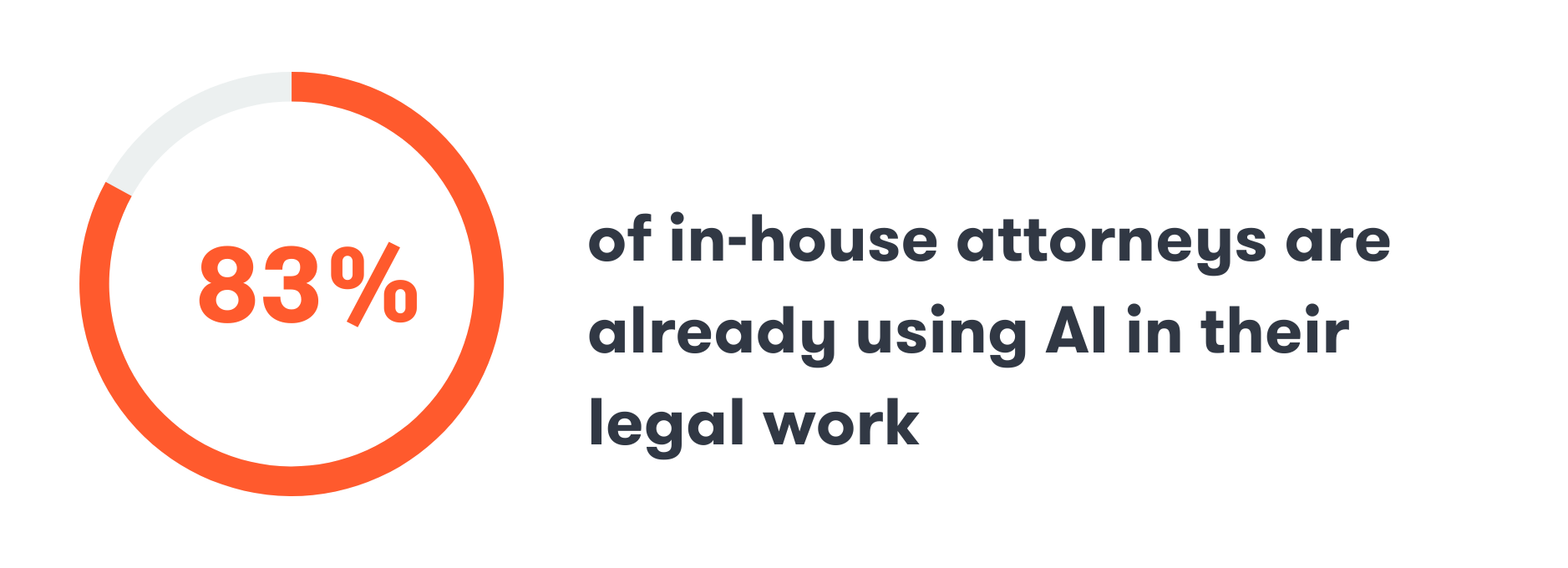
- Even more important, 83% of in-house attorneys are already using AI in their legal work, with 40% leveraging AI-driven language models like ChatGPT and Bard.
QUESTION 4:
How are my peers using AI in their daily legal work?
In-house lawyers say they use LLMs to address six types of legal matters, in this order:
- Drafting legal contracts
- Other legal document creation
- Document review
- Legal research
- Data analysis related to predicting legal outcomes
- Contract analysis
How do they do that? It’s easier than you think. Let’s take use case number one: drafting legal contracts. Simply ask ChatGPT to write a contract. You provide the critical information needed, the purpose of the contract, and examples of previous contracts. It then provides you with a draft.
Yes, it’s that simple – or at least, it can be.
QUESTION 5:
How else will AI impact legal work?
AI will impact some practice areas more than others. In-house lawyers point to a top-five list of practice areas that will soon require AI-specific legal expertise:
- Data privacy and cyber security
- Regulatory and compliance
- Intellectual property
- Commercial and contract law
- Labor and Employment
QUESTION 6:
Are my peers using AI for non-legal-related work?
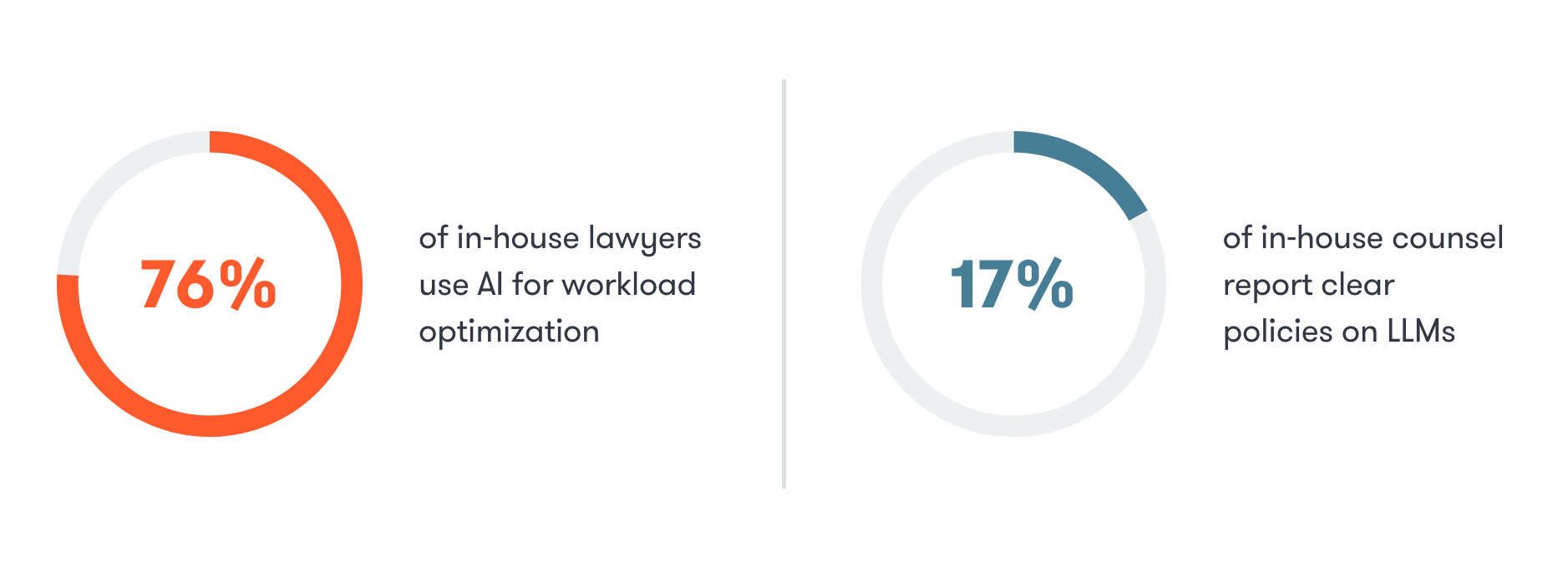
Yes. In fact, 76% of in-house lawyers use AI for workload optimization. Think about routine, time-consuming administrative functions – for example, copying text from a PDF into a Word doc without the need to further address formatting or edits, or summarizing lengthy client emails.
QUESTION 7:
Isn’t anyone concerned about the risks posed by AI?
Again, yes. In fact, lawyers are overwhelmingly concerned on two fronts.
First, more than half (56%) of lawyers are concerned that AI will replace them. They’re worried about job security.
And then there are the 58% of lawyers who have come to the opposite conclusion. They believe that workplace AI will introduce more risks to the enterprise, requiring even more legal oversight and supervision. They’re not worried that AI will replace them, they’re worried that AI will overwhelm them.
QUESTION 8:
Has legal evolved in step with AI risks?
No. Most lawyers believe AI introduces inherent risk to the organization, and yet most organizations don’t have a clear AI policy.
Only 17% of in-house counsel report clear policies on LLMs. Fifty-two percent of lawyers say their organization does have a policy, but it is so ill-defined or unevenly enforced as to render it pointless.
The Bottom-Line:
Will technology replace lawyers? Extremely unlikely. What is likely (in fact, inevitable) is that it will replace the more mundane aspects of what lawyers do with more precision and accuracy. The good news is that, as a result, lawyers will be able to deploy their immense skills to the core issues that require judgment, creativity, innovation, and empathy.
The bad news is that it will introduce exponentially more risk into the organization. This risk will require the legal department to do two things quickly:
- Be proactive in creating enterprise-wide policies on workplace adoption of AI.
- Acquire high-in-demand, short-in-supply lawyers with proficiency in how AI will impact existing practice areas
💡 Axiom can support you on AI-related legal matters and in practice areas heavily impacted by Artificial Intelligence.

