



Is this what a tipping point looks like? At a time when in-house budgets are shrinking, General Counsels face formidable challenges navigating a resource-constricted landscape that is replete with new risks, new technologies, new regulations, and big questions around resources, budgets, values and strategy.
And yet, the members of a recent panel of General Counsels convened by Axiom were more optimistic than anxious about the state of affairs in 2024 and quick to see opportunities in every uncertainty and solutions in every problem. Dynamic, flexible, innovative; that’s how they described their responses to today’s challenging environment.
Teeing off from Axiom’s third-annual research report, View From the Top: GC’s 2024 Outlook on Legal Budgets, Talent, and Innovation, that surveyed over 300 general counsels across the U.S., the panel featured:
- Ashlin Quirk, General Counsel, Axiom
- Andrew Stephens, General Counsel, MongoDB
- Brittany Leonard, General Counsel, Civix
What did our panelists reveal? Six Critical Takeaways:
- Budget constraints are forcing legal departments to work more closely with CFOs and show their impact.
- Outsourcing is a necessary but not perfect solution, so GCs need to be discerning.
- When it comes to new technologies, all that glitters may not be ROI gold.
- Make sure values don’t lose in the tug of war over budgets.
- Great GCs learn how to manage their stress and the stress of their teams!
- Full spectrum legal service and solutions providers offer more flexibly and cost-effectiveness.
Takeaway 1: Budget constraints are forcing legal departments to work more closely with CFOs and show their impact.
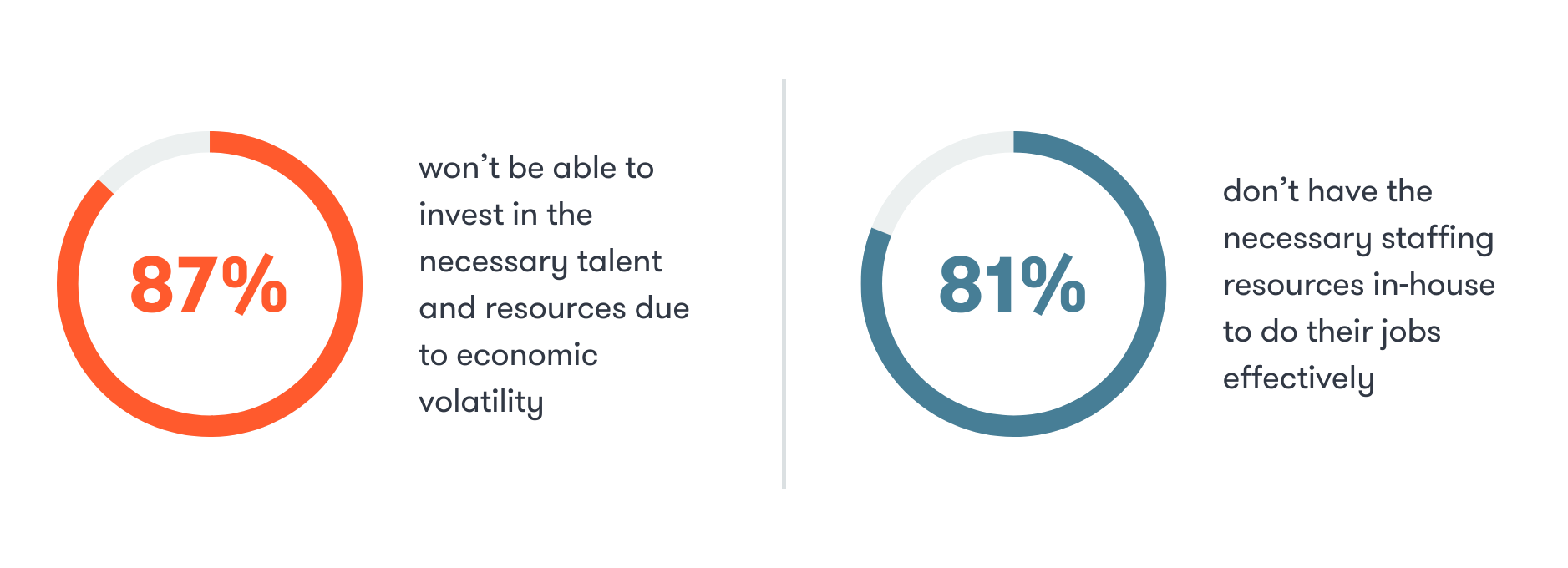
According to the survey results, 87% of GCs worry their legal departments won’t be able to invest in the talent and resources they need in 2024, and 81% say they don’t have the staffing resources in-house to do their jobs effectively.
The reality of financial headwinds set the stage for the panelists. “It’s not just legal,” Andrew Stephens observed, “it’s across the board for most companies. We’re in uncertain times at the moment and there’s a lot of change happening. It’s one of the times when you need to pay extra attention to every dollar spent because it means you’re not spending it somewhere else.”
Ashlin Quirk concurred: “I don’t anticipate budgets increasing in the near term. I think we’re all hopeful that we’ll see some flexibility in 2025.”
Under these circumstances, the risk is that finance will instinctively see legal as more of a cost center than a value driver. So, savvy legal departments are working more collaboratively with their CFO and finance departments than ever. As Brittany Leonard put it, “You may not have brought money in, but you really need to show the money you were able to keep for the company versus pay out because that’s dollars they didn’t have to spend.”
Takeaway 2: Outsourcing is a necessary but not perfect solution, so GCs need to be discerning.
No less than 100% of GCs surveyed said that it’s difficult to hire the right attorneys in-house to meet their legal needs AND those who engaged an outside law firm last year experienced challenges that led them to regret doing so.
That’s what’s called a conundrum.
The appeal of using an outside law firm must be balanced against the challenges. Stephens spoke from personal experience inside and outside legal departments: “It's very difficult for law firms to truly understand your business and your priorities. Outside counsel has numerous clients and they don't hear all the information that you hear sitting in all your executive meetings and things like that.”
Quirk offered additional challenges: “Sometimes, there’s a misperception that the law firm is going to be faster because they have teams of associates. But you don’t get the turnaround time that an in-house team provides.”
Billing is another area of concern. Sometimes there are two or three people on a call, but you get billed by the highest paid person. It’s important to be cautious and mindful of those costs. Quirk’s advice: Use outside counsel for “niche areas of the law or urgent overflow work.”
Takeaway 3: When it comes to new technologies, all that glitters may not be ROI gold.
At a time of constrained budgets, evaluating technology investments is more important than ever. Stephens, for one, said he was underwhelmed by current offerings: “The legal tech market is very, very hot at the moment, and there’s a lot of new offerings. But I would say I’ve been fairly disappointed. I haven’t seen any winners, tools that every department must have. So I think you need to be very judicious about the money and time you commit. Because legal tech changes very quickly and what looks great today likely won’t be in a year or so.”
Leonard added, “You need to be really cognizant of what you need, what it will cost, and how married you will be to this particular technology, since you’re going to have it for the next five to seven years. You’re not actually buying a $150,000 license, you’re probably looking at a $750,000 investment because it’s going to be around for a while.” Those kind of costs need to be justifiable in terms of savings such as reduced head count or some other impact.
Artificial intelligence (AI) is an example of a hot technology many can’t resist right now. But our panelists were more cautious. It’s an exciting area that they are monitoring closely. But, according to Stephen, AI is not “ready for broad use yet because there are so many questions, including who owns the inputs and outputs.” Some GCs even have policies against AI use on work computers.
While AI can speed up processes, it’s not going to replace lawyers in the short term. At the end of the day, a lawyer will still likely have to step in to any process.
Takeaway 4: Make sure values don’t lose in the tug of war over budgets.
GCs are often considered the stewards or keepers of a company’s values because of their cross-organizational view and the strong alignment between compliance and ethics. As Stephens put it, “If the values of your company are important, you need to figure out how to tie your budget to those values.” At the same time, budget cuts can sometimes inadvertently jeopardize legal’s power to prepare for or cover all contingencies and maintain the quality of services the organization is providing.
Once again, communication with the C-suite is key. Stephens said, “If you’re providing less than perfect service in an area because of a budget cut, I think you need to speak to that and say, ‘We’re cutting X,Y, and Z so that’s going to mean the organization may not be able to rely on us as much as they have in the past in that area.’”
Leonard added, “I have a standing agreement with our CFO where he completely understands that we don’t budget for litigation but if something arises, we need to find the money. It’s as simple as that.”
In other areas, where risk is not as high but budget must still be cut, “you just spend less and manage it even tighter,” Leonard said. It’s important to talk with the finance team about liabilities and coverage.
Budget cuts can also have an adverse affect on morale and motivation. Being transparent with the legal team is important. And that transparency can help encourage the team to get more involved by being creative and innovative around doing more with less.
The top five reasons GCs feel their role as the primary steward of the company’s values is more important today than in years prior:
-
Ensuring compliance with industry regulations
-
Matters related to environmental, social, and governance (ESG)
-
Matters related to diversity, equity, and inclusion (DEI)
-
Increasing privacy concerns related to artificial intelligence (AI)
-
Economic instability
Takeaway 5: Great GCs learn how to manage their stress and the stress of their teams!
It’s a tough job. Our panelists were united in agreeing that stress management is important. Stephens is a “huge believer in exercise” and recommended a regular exercise program, whatever that form of exercise may be.
In addition to exercise and family time, Leonard advised writing down a to-do list of the key things you want to get out of the day: “Focus on two or three things that are really important.”
And Quirk added, “Manage your own calendar. Don’t leave it open. You have to block time for yourself to get your work done. Otherwise, every minute will be filled up with a meeting or a zoom call.”
Takeaway 6: Full-spectrum legal service and solutions providers offer more flexibly and cost-effectiveness.
As the panelists emphasized, sometimes legal needs cannot be met in-house but it’s too expensive to send that work to a law firm. In those cases, many organizations turn to alternative legal services providers (ALSPs). But those ALSPs may not have everything you need. Increasingly, more innovative GCs are working with full-spectrum providers that offer a broader range of services.
Quirk described the challenge of balancing the workload of a full-time employee with the need to turn to an outside service provider. Acknowledging that burden and seeking help can be a way of showing responsiveness to your internal team’s needs without committing to another full-time hire. That kind of flexibility is especially helpful at a time when budgets are constrained. Likewise, if the internal team lacks a particular practice area, specialized help can be very impactful. “Getting someone who’s been there done that before can be really attractive,” Stephens noted. “Or maybe it’s one quarter of a person that you need at the moment but not for the long-term.”
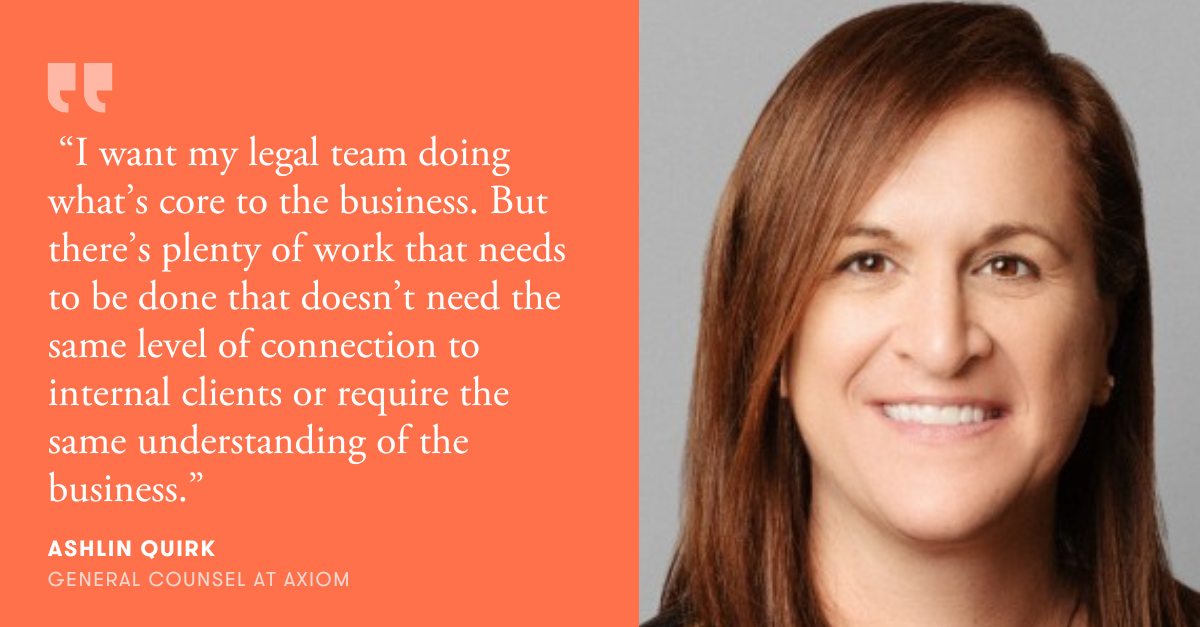
As Quirk added, “I want my legal team doing what’s core to the business. But there’s plenty of work that needs to be done that doesn’t need the same level of connection to internal clients or require the same understanding of the business.”
But it’s also important, Stephens advised, “to build a trusting relationship with your outside providers. And you can only do that by investing time. Let them get to know your business and go through a few tough issues with them to see how they progress. And don’t be afraid to give them feedback. The good firms will be receptive to feedback. The bad ones will just want to bill you.”
Top seven reasons GCs said flexible talent providers would be an appropriate and effective solution for resourcing challenges:
-
Specialized industry/practice knowledge
-
Practical, rather than conceptual, advice
-
Greater efficiency than investing in another fulltime department lawyer
-
Better value for every budgeted dollar
-
Prioritization of my business
-
Quick onboarding
-
Easy administrative management
💡 Want more insights?

