


Do You Really Need the Expense of a Law Firm in an Inflationary Economy?
January 2022
Posted by
Axiom Law
The question is not: Do you need a law firm? Of course you do. Elite law firms will always have a place in the legal resourcing ecosystem. The right question, instead, is: When do you really need that law firm? The answer may be: Not in this inflationary economy.
Per a report released January 12 by the U.S. Labor Department, inflation plowed ahead at its fastest 12-month pace in nearly 40 years during December. Commercial leaders, already dealing with a pandemic-induced volatile economy and a disrupted supply chain, are struggling to keep costs in check in order to maintain profit.
Legal leaders must also play a role in minimizing costs, but they have the added burden of ensuring that reducing costs does not come at the expense of risk mitigation – especially at a time when legal risks and workload are ballooning, not shrinking.
As we start the new year, legal leaders can play a role in hedging against the costs of inflation by rethinking the traditional legal paradigm.
What does that mean? It means taking a hard look at their approach to anticipating and identifying risks, and mapping related legal matters to the most appropriate legal resources.
Today many GCs are hiring firms for overflow work to support a resource-constrained legal team, to handle exceptional events, or when the in-house team lacks specialized expertise. Or they’re hiring full-time lawyers to handle emerging specialty needs, even though those needs may not be permanent or warrant the expense of fixed headcount.
Innovative GCs know that the right legal resource is no longer a binary choice between staffing up (internally) or sending out (to an external law firm). The right legal resource, particularly in an inflationary market where cost mitigation is paramount, is often agile legal talent.
What’s more, GCs who are particularly progressive and forward-looking are not just hiring one on-demand lawyer for overflow work. Instead, they’re building a virtual bench of “always-on” flexible talent that sits between the in-house team and the firm, combining Big Law–level expertise with in-house acumen. This agile bench helps the internal team achieve four critical objectives:
- Improve risk mitigation by matching legal matters to the right legal talent, in the moment, especially during market volatility
- Extend in-house expertise by limiting what needs to be sent to a law firm (and when)
- Decrease costs by minimizing law firm spend and permanent in-house hires as attrition continues to grow
- Reduce the burden on in-house counsel by providing practical, business-focused oversight to teams tasked with managing an increasing number of law firms
The ideal legal paradigm is a three-part model, consisting of a core, bench, and firm (CBF).
Part 1: The legal department
Part 2: A virtual bench
Part 3: The law firm
Instead of leveraging law firms because the in-house team is simply too busy, or not well-versed enough in the specialty, a CBF model funnels legal matters through a process that confines law firm engagement to exceptional events, like navigating during the pandemic and new benchmarking needs; or provides a mechanism for more finely focusing how and when, during the course of a legal matter, external firms get called upon for counsel. As inflation grows to unimaginable levels, the traditional law firm is just not a feasible option for many organizations.
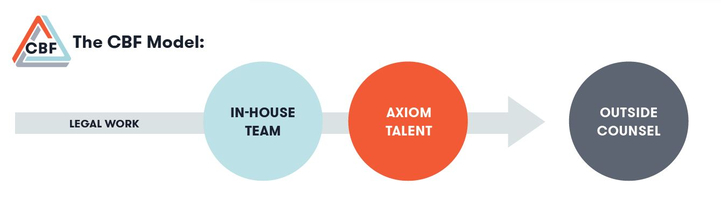
This CBF approach to legal resourcing minimizes expensive law firm spend while simultaneously reducing the fixed costs of permanent headcount, especially as legal departments find themselves affected by an inflationary economy and more short-staffed than ever.
This doesn’t just control costs; it provides the legal department with better value for every budgeted dollar. Instead of expensive external outside counsel, an in-house generalist not well-versed in the matter, or an underutilized specialist, that bucket of legal spend can be re-deployed and divided among a curated bench of on-demand lawyers, based on needs and risks in the moment. Not only does it provide more value and managerial scale, but it also optimizes risk management by ensuring the right talent is matched to the right legal matter at the right time.
This bench is a true extension of the team, imbued with the required institutional knowledge of the enterprise, but without the fixed costs of full-time employees. For specific projects, that bench can displace law firms entirely.
To learn more about how GCs can remain agile and efficient during an inflationary market, read our full report: When Do You Really Need the Expense of a Law Firm?
Posted by Axiom Law
Related Content
The Insourcing Revolution Is Here. And It’s Bigger Than Anyone Expected.
In-house legal teams are insourcing more work than ever, fueled by AI. Axiom's Chief AI and Talent Officer explains why 'possible' isn't 'sustainable.'
How the Top Seven Percent of Legal Teams Prove AI ROI
100% of legal teams are increasing AI spend, but only 7% can prove ROI. Learn the strategies top-performing legal teams use to scale AI successfully.
AI-Generated Marketing Content Compliance: A Checklist for Legal Teams
Learn how legal teams can streamline AI marketing compliance with a practical checklist for risk, review workflows, disclosures, governance and AI use.
Washington My Health My Data Act & Other Privacy Frameworks
Learn how Washington's My Health My Data Act compares with HIPAA and state privacy laws, who must comply, and what businesses need to do.
5 Forces Reshaping the Legal World Gradually, Then Suddenly
Five converging forces are reshaping the legal market—from AI and capital investment to rising costs and buyer power. GCs now have the upper hand.
How to Implement Legal AI: 5 Principles for In-House Teams
Discover five proven principles for successful legal AI adoption and implementation, from training and governance to pilots, measurement and human oversight.
What Is Shadow AI? The Growing Risk Inside Legal Departments
Learn what shadow AI is, why it puts legal departments at risk, and how to govern AI with clear policies, approved tools, training, and oversight today.
How AI-Enabled Legal Teams Are Transforming M&A Due Diligence and Contract Review
Discover how AI-enabled legal teams accelerate M&A due diligence and contract review while combining legal expertise with AI for faster, smarter results.
APAC Regulatory Fragmentation in 2026: What In-House Legal Teams Need to Know
APAC regulations are diverging fast. Learn how in-house legal teams can prioritize compliance, manage risk, and adapt to evolving rules.
AI Privacy Risks: What Legal Teams Need to Know Before Employees Use Public AI Tools
Legal teams face growing AI privacy risks. Learn how public AI tools can expose sensitive data, impact privilege, and create compliance challenges.
The Legal Profession Isn’t Ready for What's Coming: Richard Susskind's Unfiltered Take from Axiom's London Event
Richard Susskind shares a candid vision of AI's impact on law, urging legal leaders to prepare now for AGI, disruption, and transformation.
The Era of the Law Firm Panel is Ending
Law firm panels were built for a different era. Today's GCs need a dynamic portfolio of law firms, ALSPs, AI, and in-house talent to source work strategically.
Legal AI’s ROI Mirage
Legal departments are investing heavily in AI, yet most can't prove its value. Explore the ROI gap revealed in Axiom's 2026 AI report.
How Legal Departments Can Prove ROI from AI Implementation
How legal departments can measure and prove AI ROI with practical frameworks, key metrics, and strategies for turning efficiency gains into budget impact.
We Were Both Wrong About Legal AI. Here’s What Changed Our Minds.
Learn how Axiom's CTO and DraftPilot's CEO went from legal AI skeptics to believers—and the three assumptions they think most legal teams still get wrong.
What Are Export Controls? ITAR & EAR Explained
Export controls explained. Learn the differences between ITAR, EAR, and OFAC, key compliance risks, enforcement trends, and what businesses need to know.
Legal Project Management: Improve Efficiency and Control Costs
Learn how legal project management improves efficiency, controls legal costs, strengthens communication, and delivers predictable outcomes.
What Is Legal Tech? A Guide for In-House Legal Teams
A clear guide to legal tech for in-house teams—what it is, key tools, benefits, and how to implement it to boost efficiency and reduce costs.
- North America
- Must Read
- Expertise
- Legal Department Management
- Work and Career
- Perspectives
- Corporate & Commercial
- Legal Technology
- United Kingdom
- Australia
- Hong Kong
- Singapore
- State of the Legal Industry
- Technology & AI
- Central Europe
- Legal Operations
- Legal Support Professionals
- Projects
- Regulatory & Compliance
- Tech+Talent
- Data Privacy & Cybersecurity
- Talent Spotlight
- Technology
- Secondments
- Global
- Specialized Advice
- Axiom in the News
- Finance & Capital Markets
- Healthcare & Life Sciences
- Intellectual Property
- Law Firms
- Recruitment Solutions
- Cost Savings
- Featured Talent Spotlight
- GC Report
- Diversified Financial Services
- Labor & Employment
- M&A & Divestitures
- Budgeting Report
- Energy
- Investment Banking
- Banking
- Construction
- Consulting
- Consumer Packaged Goods
- In-House Report
- Manufacturing
- Materials
- Pharmaceuticals
- Professional Services
- Retail
- Transportation
- AI Survey Report
- Aerospace & Defense
- Automotive
- Business Services
- Consumer Services
- DGC Report
- Education
- Food & Beverage
- Hospitality
- Insurance
- Litigation & Dispute Resolution
- Private Equity
- Public Sector
- Real Estate
- Telecom
- Utilities
- Media
- TEST TAG NAME CHANGE
Get more of our resources for legal professionals like you.