

How Axiom Calculates 30–50% Legal Cost Savings
Axiom helps companies reduce certain categories of legal spend by 30–50% compared with traditional outside-counsel delivery, depending on the type of work, baseline law-firm cost, utilization, and scope fit. In some engagements—particularly high-volume, well-scoped, repeatable work—actual savings can exceed this range; 30–50% reflects a representative estimate across a broad set of engagement types, not a ceiling.
This is not marketing hype. It’s actual, demonstrable savings. It’s not based on a comparison of a single Axiom attorney versus a selected law firm partner rate, but rather a real-world comparison of Axiom average blended rates against blended delivery costs of outside counsel––adjusted for the practical frictions that can reduce gross savings.
-
Here, we’ll illustrate the methodology behind that range and provide some examples. Of course, savings can vary by matter type, baseline, scope, and client operating model.
-
The 30–50% range is most relevant where work can be shifted from traditional law firms to Axiom talent without requiring full outside-counsel team replacement.
The Baseline: Traditional Outside-Counsel Delivery
The savings calculation starts with what a company would typically pay under a traditional outside-counsel model—not a single, cherry-picked partner rate, but a realistic blended cost across the team actually staffed on a matter: partner, associate, and paralegal or legal-operations time combined.
Where available, the baseline reflects the client's own realized outside-counsel spend, including any volume or negotiated discounts already in place. This avoids two common distortions: comparing Axiom only to the most expensive lawyer on a deal, and ignoring discounts many companies have already secured with their firms. The result is a baseline built on what a client is actually paying today—not a rate-card number that no one pays in practice.
How Axiom’s Rates Compare with Am Law 200 Bill Rates
Traditional law firm rates vary significantly by firm rank and seniority, but Am Law 200 benchmark data shows that average hourly bill rates are meaningfully higher than Axiom’s blended rate range. Axiom’s model avoids many of the cost drivers associated with traditional law firms, including profit-per-partner economics and high fixed overhead.
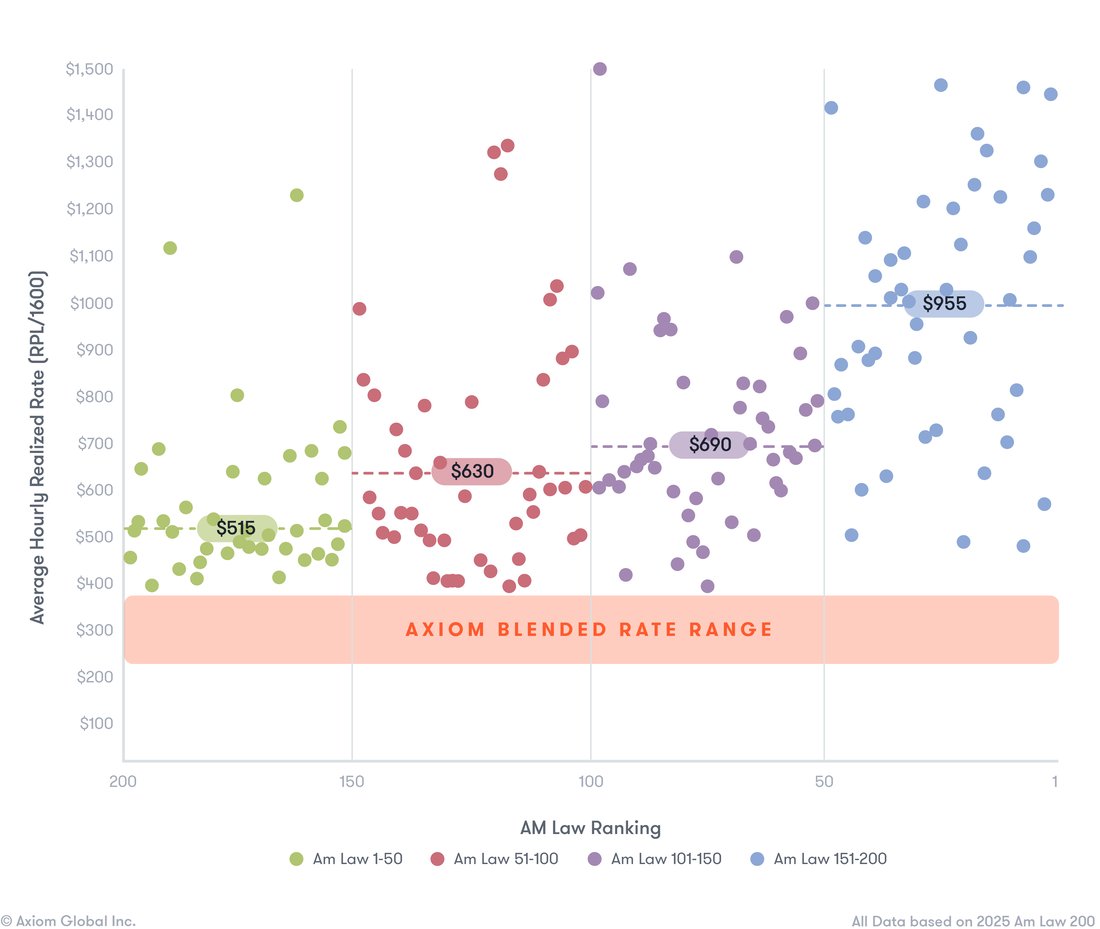
Axiom’s blended hourly rate range of $152 to $375 sits below the average hourly bill rate of every Am Law 200 tier, with the gap widening as firm rank rises: from $516 in the Am Law 151–200 tier to $990 in the Am Law 1–50 tier.
Table 1: Average hourly realized rate by Am Law 200 tier, compared with Axiom’s blended rate range. Firm data based on 2025 Am Law 200, published by ALM Global; hourly rate = revenue per lawyer ÷ 1,600 billable hours, all 200 firms.
| Segment | Avg. hourly realized rate | Difference vs. Axiom range |
|---|---|---|
| Am Law 1–50 | $955/hr. | +$580 to +$803/hr. |
| Am Law 51–100 | $690/hr. | +$315 to +$538/hr. |
| Am Law 101–150 | $630/hr. | +$255 to +$478/hr. |
| Am Law 151–200 | $515/hr. | +$140 to +$363/hr. |
| Axiom blended rate range | $152–$375/hr. | — |
What “Blended-Rate Basis” Means
A blended-rate comparison estimates what a client would likely pay for the same category of work under a traditional outside-counsel model, using a mix of timekeeper levels rather than only a single partner or associate rate.
Traditional Model vs. Axiom
Traditional model
Partner + associate + paralegal / legal operations time, blended into an average hourly matter cost.
Axiom model
Axiom legal talent cost, plus any client-side supervision, onboarding, or management time needed to make the engagement successful.
How Axiom’s Rates Compare with Other ALSPs
Axiom’s pricing is also competitive when compared with other alternative legal service providers. In the benchmark shown below, Axiom is indexed at 100, with other ALSP bill-rate benchmarks shown relative to that level.
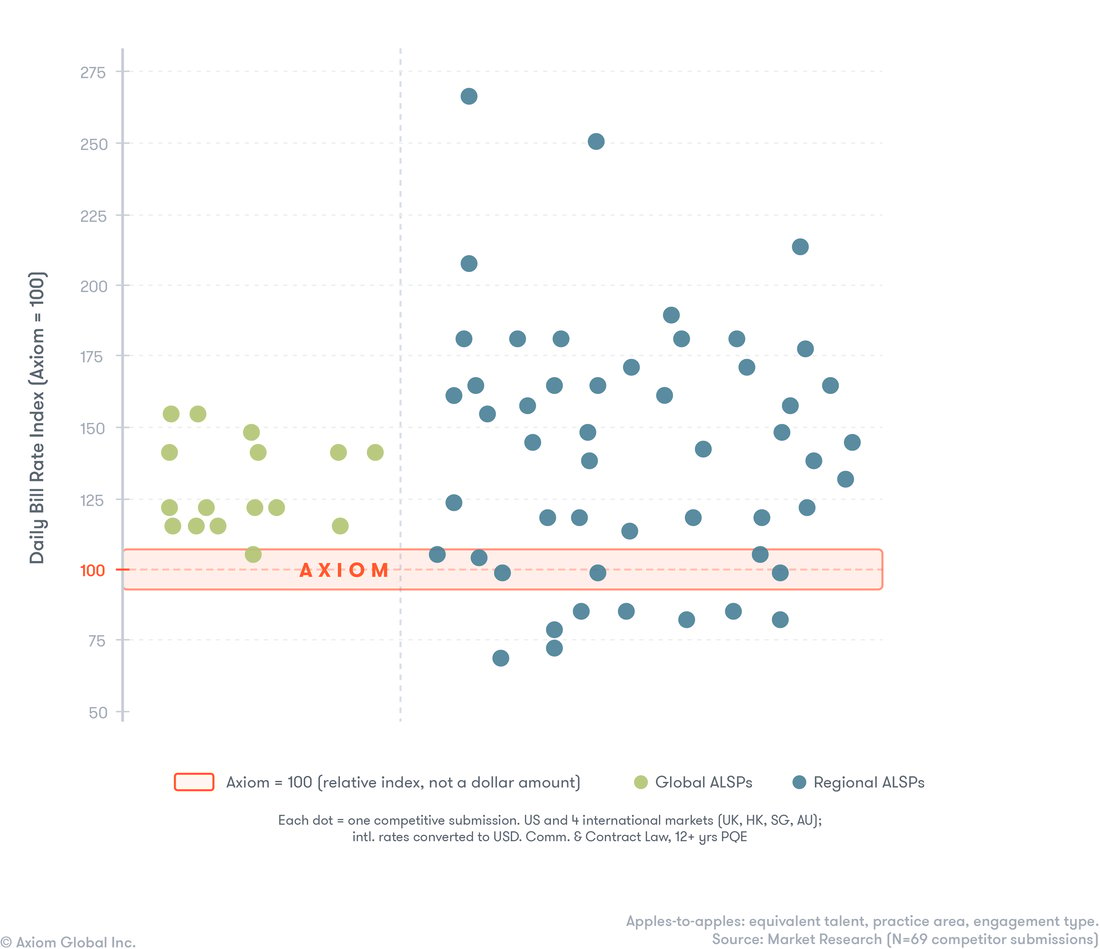
Axiom is indexed at 100. Across all 69 competitor submissions the median daily bill rate index is 141, and 54 of 69 submissions price above the top of the Axiom band. Global ALSPs cluster in a narrow range; regional ALSPs spread far wider in both directions.
Table 2: Daily bill rate index by provider group, Axiom = 100. Derived from the 69 plotted submissions. Source: third-party independent market research, N=69 competitor submissions across the US and four international markets (UK, Singapore, Australia, Hong Kong); international rates converted to USD. Commercial & Contract Law.
| Provider group | Submissions | Median index | Range | Above Axiom band |
|---|---|---|---|---|
| Global ALSPs | 16 | 122 | 105–155 | 15 of 16 |
| Regional ALSPs | 53 | 145 | 69–355 | 39 of 53 |
| All competitor submissions | 69 | 141 | 69–355 | 54 of 69 |
| Axiom | — | 100 | 93–107 (band) | — |
Index values are read from the plotted positions of each submission. 2 regional submissions price above index 300 and fall outside the visible plot area.
Axiom bill rate index compared with global and regional ALSP benchmarks.
The Savings Formula
Axiom’s estimated savings are calculated by comparing the expected cost of traditional outside-counsel delivery with the expected cost of shifting appropriate work to Axiom, then applying deductions for real-world transition and management costs.
The Formula:
Traditional outside-counsel baseline cost − Axiom delivery cost − deductions for ramp, supervision, transition, and unused capacity = net savings
Expressed as a Percentage:
Net savings ÷ traditional outside-counsel baseline cost = savings percentage
The 30–50% estimate should represent net savings after practical deductions, not theoretical rate savings. Ramp, supervision, transition friction, and unused capacity are the specific deductions behind that formula.
What Work Is Shifted to Axiom?
The work itself spans nearly everything law firms handle. M&A transactions. Complex litigation support. Regulatory compliance programs. Data privacy initiatives. Real estate transactions. The full spectrum of legal services, delivered with the same rigor and expertise you expect from elite firms. And it is often delivered with more experienced lawyers.
Law firms typically staff matters with junior and mid-level associates who are still learning. Axiom deploys lawyers averaging 18 years of post-qualification experience. These are former Am Law 100 partners and Fortune 500 in-house counsel who work faster, require less supervision, and deliver higher quality work from day one.
The bottom line: The more appropriate hours that shift from high-cost outside counsel to Axiom, the greater the potential savings.
Real World Example
Results: ~$6M in annual savings across five practice areas
A top-five industrials sector leader needed to cut outside costs across the board, and enlisted Axiom to help reduce its outside legal spend. Axiom lawyers now support the client’s bandwidth-constrained in-house team on procurement, commercial/contract, privacy, employment, and regulatory compliance matters.
Across all practice areas, Axiom’s weighted average attorney rate for the client averaged $250 per hour less than the client’s law firm rate, resulting in nearly $6M in savings. The following are illustrative examples from two practice areas:
Practice Area
Axiom Blended Rate
Law Firm Average
Contracts & Commercial Law
Axiom Blended Rate
$152/hr.
Law Firm Average
$631/hr.
Labor & Employment
Axiom Blended Rate
$275/hr.
Law Firm Average
$435/hr.
When Savings May Approach the Higher End of the Range
Axiom savings may be closer to 50% when:
- The work is repeatable and well-scoped.
- The traditional baseline is a high-cost law firm model.
- The client can shift a meaningful volume of hours.
- Axiom talent can operate with limited ramp time.
- The client does not need a full partner-led law firm team.
When Savings May Be Closer to the Lower End of the Range
Savings may be closer to 30% when:
- The work requires more supervision or escalation.
- The client’s outside-counsel rates are already heavily discounted.
- Scope is less predictable.
- Ramp time is meaningful.
- The engagement replaces only part of the outside-counsel workflow.
- Utilization is moderate rather than high.
Does Axiom compare its rates only to law firm partner rates?
No. The methodology compares Axiom’s cost against a realistic blended outside-counsel baseline that may include partner, associate, and other timekeeper costs.
Are the 30–50% savings guaranteed?
No. Savings depend on matter type, baseline cost, scope, utilization, and implementation.
What types of work are best suited for Axiom savings?
Repeatable, ongoing, or well-scoped legal work such as commercial contracts, product counseling overflow, compliance support, privacy support, employment support, and secondment-style embedded work.
Why does Axiom apply deductions to savings estimates?
Because gross rate savings can overstate the real result. Deductions for ramp, supervision, transition, and management time produce a more realistic net savings estimate.
How are Axiom’s rates different from traditional law firm rates?
Axiom’s rates are generally lower because Axiom does not operate under a traditional law firm profit-per-partner model or the same overhead structure.